Medically reviewed by Veronica Diaz, MD | Reviewed July 2026
Not every damaged structure in the shoulder needs to be rebuilt or replaced. Sometimes the better option is simply to clean it up. Shoulder debridement is one of the more common procedures I perform, and it’s also one of the more misunderstood ones, since patients often assume any shoulder surgery involves repairing or replacing something. Understanding when debridement makes sense, and when it doesn’t, can help you feel more prepared going into a conversation about your own treatment options.
Key Takeaways
- Shoulder debridement is an arthroscopic procedure that removes damaged, frayed, or loose tissue from the joint rather than repairing or replacing it.
- It’s often considered for tears that can’t be fully repaired, certain labral injuries, impingement-type symptoms, or milder joint damage.
- Recovery is generally more straightforward than after a repair, though this depends on what else is addressed during the same surgery.
What Shoulder Debridement Actually Involves
Shoulder debridement is performed arthroscopically, meaning I work through a few small incisions, typically about the size of a buttonhole, using a camera and specialized instruments. Rather than reattaching or reconstructing tissue, the goal is to remove what’s damaged: frayed cartilage, loose fragments, or inflamed tissue that’s contributing to pain. This may be done alongside other arthroscopic shoulder procedures, since it’s common to find more than one issue once we’re inside the joint.
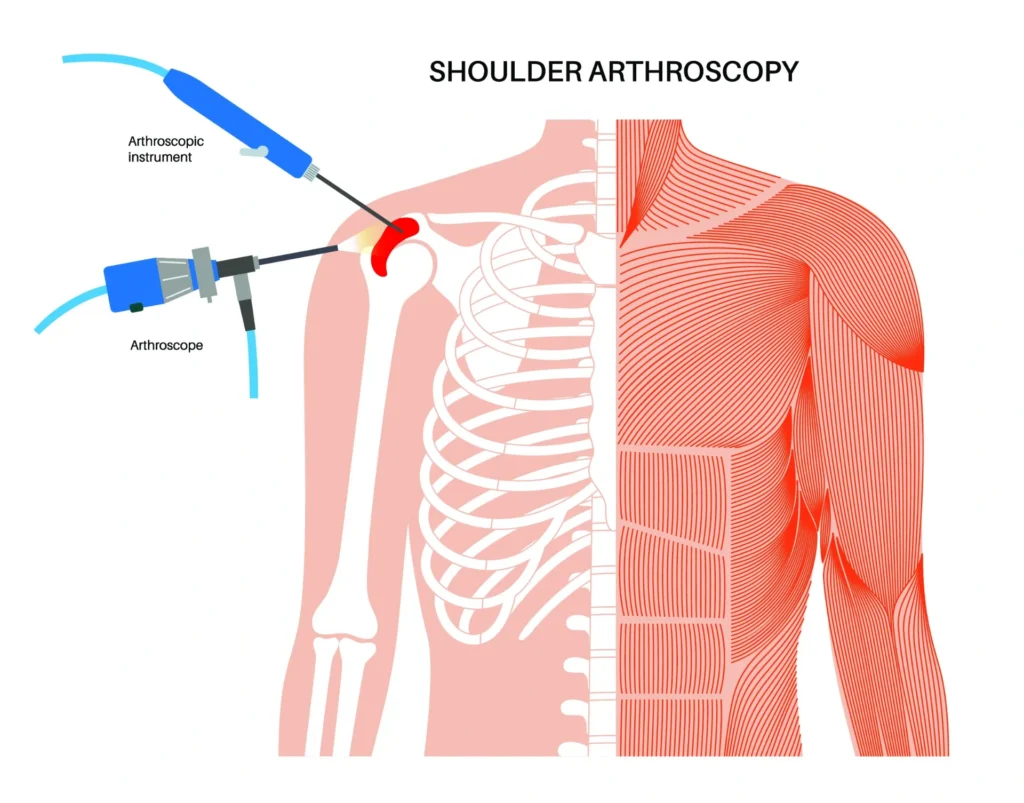
Because the incisions are small and the procedure is minimally invasive, most patients go home the same day. The exact duration of the procedure depends on how much needs to be addressed once I’m able to see the joint directly.
Conditions That May Call for It
A few clinical situations come up most often. Certain SLAP lesions, tears of the labrum where the biceps tendon attaches, are increasingly treated with debridement of the injured tissue combined with a rerouting or release of the biceps tendon, rather than an attempted repair. Some rotator cuff tears fall into a similar category. When a tear has become too large or the tissue quality is too poor for a durable repair, debridement may be considered instead of repair, particularly if surgery is being pursued mainly for symptom relief. Impingement-related pain, bone spurs, and inflamed bursal tissue are other common reasons debridement, sometimes paired with a subacromial decompression, becomes part of the plan.
Mild arthritis is another situation where debridement sometimes comes up. Removing loose cartilage fragments and smoothing rough joint surfaces can meaningfully ease symptoms for a period of time, even though it doesn’t reverse the underlying arthritis. It’s a way of buying comfort and function without committing to a larger procedure before it’s truly necessary.
Debridement Versus Repair: How the Decision Gets Made
Patients regularly assume that more tissue removed means a bigger problem, or that debridement is somehow a lesser option compared to repair. Neither is really accurate. The decision comes down to what’s actually salvageable. If a torn tendon has good tissue quality and can be reliably reattached, repair is usually the better long-term choice, since it restores the tendon’s original function. If the tissue is too frayed, retracted, or degenerated to hold a repair reliably, forcing one anyway can lead to a higher chance of re-tearing without much added benefit. In that situation, cleaning up the damaged tissue and smoothing the remaining surfaces can relieve pain and improve motion without the added risk of a repair that isn’t likely to hold.
Why Conservative Treatment Comes First
Whenever possible, I want to use the least invasive approach with a reasonable chance of helping, and that means starting with nonsurgical care. Physical therapy, activity modification, anti-inflammatory medication, and targeted injections all have a role. For appropriate candidates, PRP therapy is worth discussing as well, particularly for tendinopathy or earlier-stage joint changes. Debridement tends to be considered once these measures haven’t provided lasting relief, or when imaging shows a problem that’s unlikely to improve without addressing the damaged tissue directly.
Mechanical symptoms change this calculation somewhat. Catching, locking, or a sensation that something is physically blocking motion inside the joint often points to a loose fragment of tissue that conservative care simply can’t resolve, since there’s nothing for physical therapy or medication to fix if debris is physically obstructing the joint. In those cases, I tend to move toward a surgical evaluation sooner rather than cycling through months of treatment that’s unlikely to address the actual problem.
What I See in My Patients
My Palm Beach County practice sees a lot of active patients, golfers, tennis players, paddleboarders, who come in after months of nursing a shoulder that just isn’t cooperating anymore. Many have already tried rest and over-the-counter anti-inflammatories on their own before scheduling a visit. For a meaningful number of these patients, once imaging and examination clarify what’s going on, debridement turns out to be a reasonable, less invasive path back to their sport rather than a more extensive repair.
I also see this come up frequently in older patients who have some degree of shoulder arthritis along with a mechanical symptom, like catching or locking, that’s tied to loose tissue inside the joint. For someone who isn’t ready for a shoulder replacement, or whose arthritis isn’t advanced enough to warrant one yet, debridement can sometimes buy meaningful relief and delay a bigger procedure, even though it isn’t a permanent fix for arthritis itself.
My Approach to Treatment
I don’t treat debridement as a stand-alone decision made in isolation. It’s usually one piece of a broader arthroscopic plan, which might also include a decompression, a biceps tenodesis, or addressing a partial tear elsewhere in the joint, depending on exactly what I find. Before recommending it, I want a clear picture from your history, exam, and imaging, and I want you to understand why debridement is the right tool for your specific situation rather than a repair or a more involved procedure.
I also set expectations carefully going in. Debridement can relieve pain and improve motion meaningfully, but it doesn’t regrow cartilage or reverse arthritis, and it doesn’t restore a tendon that’s been removed rather than repaired. For the right patient, that trade-off makes complete sense. For someone hoping the procedure will functionally rebuild a badly damaged joint, it’s important we’re on the same page beforehand about what it can and can’t accomplish.
What Recovery Generally Looks Like
Because debridement removes tissue rather than reattaching it, the early recovery is often more comfortable than it is after a repair, and there’s typically less restriction on motion in the first few weeks. That said, recovery still varies depending on what else was addressed during your surgery, your overall health, and how your shoulder responds. I’ll walk you through a recovery timeline specific to your procedure rather than a generic one, since debridement alone and debridement combined with other repairs can look quite different in terms of what to expect week to week.
Summary
Shoulder debridement isn’t the right answer for every torn or damaged shoulder, but for the right patient, it can be an effective, less invasive way to relieve pain and restore function. If you’ve been dealing with shoulder pain that hasn’t responded to rest and conservative care, the next step is an evaluation to find out what’s actually driving your symptoms. Call my office at (561) 746-7686 or schedule a consultation online to get started.
Frequently Asked Questions
Is shoulder debridement the same as a repair?
No. Debridement removes damaged or loose tissue rather than reattaching or reconstructing it. Repair involves stitching torn tissue back to bone or to itself. The two are sometimes performed together, depending on what’s found during surgery.
What conditions is shoulder debridement used for?
It may be considered for certain labral tears, rotator cuff tears that aren’t good candidates for repair, impingement symptoms, bone spurs, and inflamed bursal tissue that hasn’t responded to conservative treatment.
Will I need physical therapy after debridement?
Many patients benefit from some physical therapy to restore strength and motion. I’ll tailor this recommendation to your situation.
How do I know if debridement or a more involved procedure is right for me?
That comes down to a thorough evaluation, including your history, a physical exam, and imaging. I’ll walk you through what’s actually damaged in your shoulder and explain why a specific approach, whether that’s debridement, repair, or something else, makes the most sense for you.