Medically reviewed by Veronica Diaz, MD
The pattern I see with shoulder instability tends to go something like this. The first dislocation takes force. A hard fall, a tackle, a collision, and usually a trip to the emergency room to get the shoulder back in place. The next one takes less. By the third or fourth, patients tell me it happened reaching for something on a high shelf. That progression, from significant trauma to almost nothing at all, is the story of shoulder instability. Once the structures that hold the shoulder in place are damaged, the force required to dislocate it again keeps dropping. Understanding why that happens is the first step toward knowing what to do about it.
Key Takeaways
- Shoulder instability develops when the tissues that keep the ball centered in the socket are stretched or torn, most often after a dislocation.
- A Bankart lesion, a tear in the lower front portion of the labrum, is a common finding after a first dislocation in younger patients.
- Age matters considerably. Patients under 20 are at higher risk of dislocating again without surgical repair.
- Not every unstable shoulder needs surgery. The right answer depends on age, activity level, natural joint flexibility, and whether bone has been lost.
What Shoulder Instability Actually Is
The shoulder trades stability for motion. It moves through a greater arc than any other joint in the body. It manages that because the socket, called the glenoid, is shallow. Picture a golf ball resting on a tee rather than a hip, where the ball sits deep inside a cup.
What keeps that ball centered is soft tissue. The labrum is a ring of cartilage around the rim of the socket that deepens it and anchors the ligaments of the joint capsule. The rotator cuff, four muscle-tendon units surrounding the joint, provides active control. When those structures are working, the shoulder stays where it should through an enormous range of positions.
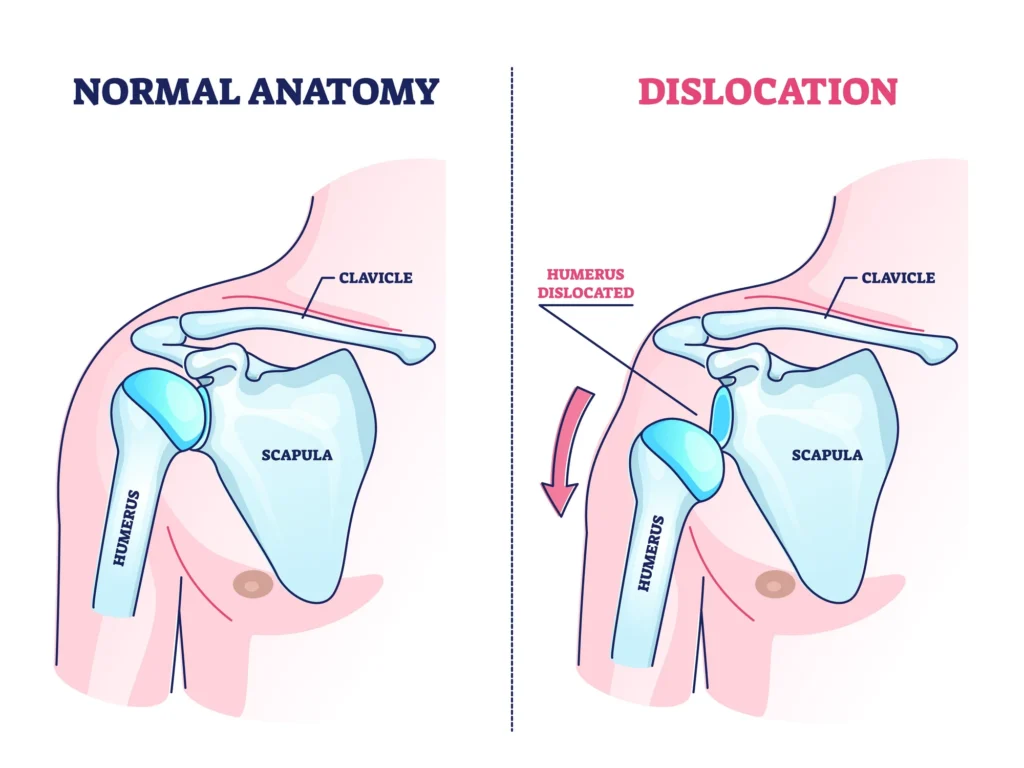
Instability is what happens when that system fails. It comes in degrees. A full dislocation means the ball leaves the socket entirely. A subluxation means it slides partway out and back. Some patients never dislocate at all and simply live with the sense that the shoulder is about to give way. My patients describe that last one as the shoulder feeling untrustworthy, particularly with the arm overhead and rotated back.
Getting the Shoulder Back in Place
Putting a dislocated shoulder back into the socket is called a reduction, and it should be treated as urgent. The longer the joint stays out, the more the surrounding muscles spasm, and the harder and more painful the reduction becomes.
In an emergency room, the shoulder might be X-rayed. It helps confirm the direction of the dislocation and looks for a fracture, because reducing a shoulder that also has a broken bone in it may make things worse. Sedation and pain medication are usually given so the muscles relax. The shoulder is then moved back into place gently and slowly. A sling follows. A second X-ray may confirm that it’s properly seated.
Patients who have dislocated several times often learn to reduce the shoulder themselves, and I understand why. It is faster, and an emergency room is not how anyone wants to spend an afternoon. My concern is what gets missed without an evaluation.
If you are at a point where you are reducing your own shoulder, that is not a sign the problem is under control. It is a sign the shoulder is unstable and deserves an evaluation by a shoulder specialist.
Why the First Dislocation Is Often Not the Last
The shoulder usually dislocates forward. The ball pushes past the front rim of the socket and typically tears the labrum away from the bone there. That injury is called a Bankart lesion. It is the anatomic reason repeat dislocations happen.
The problem is that this tissue does not reliably heal back down where it belongs. It may scar in a stretched position, or slightly off the rim. Either way, the front of the socket is now shallower than it was. Less containment means less force is needed the next time. The impact of a dislocation can also leave a dent in the back of the ball. If that dent catches on the front rim, the shoulder slips out with alarmingly little provocation.
Age is the strongest predictor of what happens next. Younger patients, particularly those under 20, face a substantially higher risk of dislocating again without surgical repair. A patient in their sixties who dislocates a shoulder falling off a bicycle is in a different situation. The tissue behaves differently, and the demands on the joint may not be the same.
Not All Instability Comes From an Injury
Traumatic instability is caused by a specific event. There is another group of patients whose shoulders are simply loose to begin with.
Some people have naturally more elastic connective tissue throughout the body. Their joints move further than average, and their shoulders may sublux in multiple directions without any injury having occurred. These patients often notice it in both shoulders. The tissue is not torn, it is lax, and this distinction changes the treatment approach completely.
There is also a middle category worth mentioning. Overhead athletes, particularly throwers, swimmers, and volleyball players, can develop instability from repetitive stress rather than a single event. Those injuries frequently involve the upper part of the labrum and are known as SLAP tears, short for superior labrum anterior to posterior. I swam competitively at Princeton and played water polo, so I have a personal appreciation for what repeated overhead loading does to a shoulder. It also gave me some early exposure to how differently athletes describe this problem. The shoulder rarely hurts in a way that sends someone to a doctor. Instead, it starts feeling unreliable.
What I See in My Patients
In Palm Beach County I see shoulder instability in two distinct populations. First are the young athletes: football, wrestling, baseball, and increasingly surfing. They dislocate traumatically and then face a real decision about repair.
Second are active adults in their thirties and forties who dislocated once in high school and forgot about it for two decades. Now certain tennis serves or paddleboard falls feel dangerous. That second group frequently believes the original injury resolved. Often it never did, and they simply organized their lives around avoiding the vulnerable position.
The finding that changes my recommendation more than any other is bone loss. When repeated dislocations wear away the front rim of the socket, a standard soft tissue repair may not hold the shoulder in place. I would much rather know that before an operation than after one. It is a large part of why I want imaging on patients who have dislocated several times.
How Instability Is Evaluated
The history usually tells most of the story. How old were you the first time? What position was your arm in? Did someone have to put it back in? How many times since? What movements do you avoid or brace for now?
On examination, I assess range of motion and strength. I also place the arm in the position that provokes the sensation of giving way and watch how the shoulder responds. Then I check overall joint flexibility, since a patient with generalized laxity needs a different plan than one with a discrete tear.
Imaging typically starts with X-rays to look at the bone, since they show fractures, dents in the humeral head, and loss of the socket rim. An MRI, sometimes with contrast dye placed in the joint, gives a clearer view of the labrum and capsule. A CT scan may be added when bone loss needs to be measured precisely.
My Approach to Treating Shoulder Instability
My starting position is that surgery should be reserved for patients whose anatomy and activities genuinely call for it. A first dislocation in an older, less demanding patient often does not meet that bar.
For patients with generalized laxity and no structural tear, a rehabilitation program generally focuses on the rotator cuff and the muscles that control the shoulder blade. It requires patience. The patients who have the most success are the ones who keep going even after the shoulder starts feeling better.
For a young, active patient with a Bankart tear and a high-risk sport, the calculation is different. Surgical stabilization is more commonly recommended in this group. Each additional dislocation causes more damage to the labrum and to the bone. A shoulder that keeps dislocating is not a situation that holds steady on its own. Most of these repairs can be performed through shoulder arthroscopy. The labrum is reattached to the rim of the socket with small anchors, through several small incisions.
When there is significant bone loss, a soft tissue repair alone may not be sufficient. That is where the Latarjet procedure comes in, moving a piece of bone called the coracoid process to the front of the socket, where it acts as a physical block against dislocation. It is a bigger operation than an arthroscopic repair, with its own recovery plan and risks. It is exactly why I would rather have this conversation early, before the socket has taken years of wear.
After a repair, the sling stays on until you are cleared, and formal therapy generally begins around four to six weeks postoperatively. Return to sport, particularly contact or overhead sport, takes considerably longer and is guided by strength and control rather than by the calendar. I would rather hold an athlete an extra month than watch them re-dislocate a repair and have to start all over again.
Summary
Shoulder instability is a structural problem, not a run of bad luck. A dislocation usually damages the labrum, most often as a Bankart lesion at the front of the socket. That damage makes the next dislocation easier. Age, activity level, joint flexibility, and bone loss all shape whether rehabilitation or surgery is the better path.
If your shoulder has dislocated, or if it feels unstable, that is worth evaluating rather than working around. To find out where your shoulder stands, schedule a consultation online or call my Jupiter office at (561) 746-7686.
Frequently Asked Questions
How do I know if I have a labral tear?
Common symptoms include a catching sensation, pain deep in the shoulder, and a feeling that the joint is slipping. Those overlap with other shoulder conditions, so diagnosis usually requires a physical examination combined with imaging. An MRI is generally the most useful study for looking at the labrum.
Will my shoulder be as strong after stabilization surgery?
Many patients regain excellent strength and function after arthroscopic stabilization. Outcomes vary with the extent of the original damage, whether bone loss was present, and how consistently a patient follows rehabilitation. Some patients may notice a small loss of external rotation.
What activities should I avoid with an unstable shoulder?
The riskiest position is usually the arm out to the side and rotated backward. Rather than a generic list of restrictions, I would rather talk through the specific activities that matter to you and build a plan around those.