Medically reviewed by Veronica Diaz, MD | Reviewed June 2026
A biceps tendon tear is one of those injuries that stops you in your tracks. In my practice, I see these tears in two very different places: at the shoulder, where the long head of the biceps attaches inside the joint, and at the elbow, where the tendon anchors to the forearm bone. Where the tear is, how severe it is, and what you need your arm to do all shape the path forward.
Key Takeaways
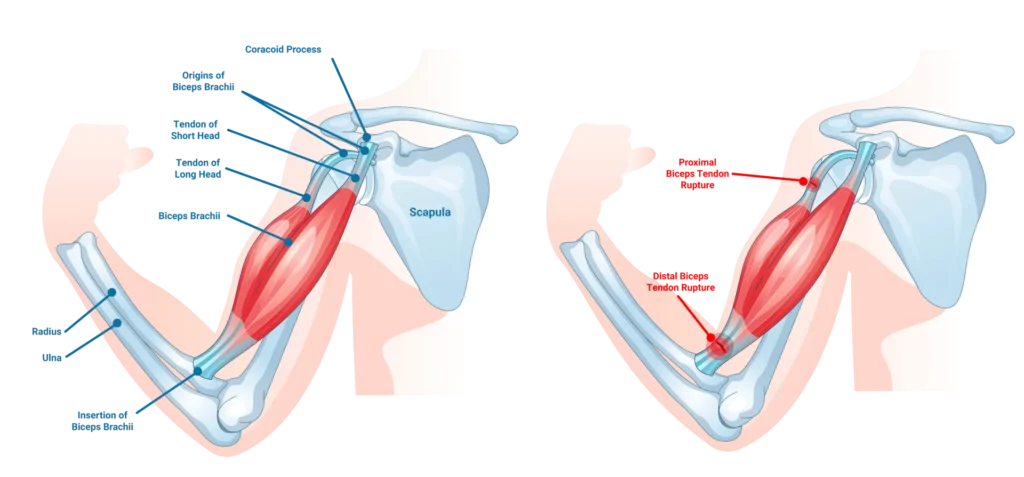
- The biceps muscle has two tendons at the shoulder and one at the elbow, and tears can occur at any of these locations.
- Biceps tendon tears at the shoulder are common and often do not require surgery; management depends on the extent of the tear and the patient’s activity level and goals.
- Distal biceps tendon ruptures at the elbow usually require surgical repair, and timing matters. Waiting beyond six weeks can make the repair more challenging.
What Is the Biceps Tendon?
The biceps muscle runs along the front of your upper arm. It bends the elbow, rotates the forearm palm-up, and helps stabilize the shoulder overhead. There are two tendons at the shoulder end (the long head and the short head) and one at the elbow, the distal biceps tendon.
The long head takes an unusual path. It originates inside the shoulder joint, traveling between two rotator cuff tendons before connecting to the muscle. Because of that location, I frequently see it involved when the rotator cuff or labrum is also damaged.
The distal biceps tendon attaches to the forearm bone at a projection called the radial tuberosity. When it tears completely, patients lose meaningful forearm rotation strength. That shows up fast in tasks like opening a jar or turning a key.
What Causes a Biceps Tendon Tear?
The cause differs depending on which tendon is involved.
Proximal biceps tears, meaning tears near the shoulder, are usually the result of gradual degeneration rather than a single traumatic event. Over time, the tendon can fray and weaken, especially in patients who also have rotator cuff disease or labral pathology. A tear may eventually occur with a relatively minor force, such as reaching into the back seat of a car, lifting a bag from the floor, or simply moving the arm in an awkward position.
Distal tears follow a different pattern. These are almost always caused by a sudden forceful load applied when the elbow is bent and the forearm is palm-up. Trying to catch a heavy falling object is a classic scenario. The tendon pulls away from the bone, and patients typically describe a pop at the elbow crease followed by sharp pain and swelling.
Distal ruptures are far more common in men between the ages of 40 and 60. Anabolic steroid use and smoking have both been associated with higher risk.
Recognizing the Symptoms
Proximal Biceps Tendon Tear (at the Shoulder)
Patients with a proximal biceps tear often describe sharp pain at the front of the shoulder, sometimes with a pop. In a complete long head tear, the muscle belly retracts toward the elbow, producing the characteristic “Popeye” deformity.
After the initial event, the shoulder frequently feels better than it did before. For patients with pre-existing biceps tendinitis, pain often resolves once the tendon is no longer under tension. That improvement can be misleading. I still recommend an evaluation, because the state of the surrounding shoulder matters for how we approach things.
Ongoing symptoms may include aching at the front of the shoulder, weakness overhead, and occasional biceps cramping.
Distal Biceps Tendon Rupture (at the Elbow)
Distal tears announce themselves. Pain at the elbow crease, bruising, swelling, and a visible change in the shape of the upper arm together leave little doubt.
Patients report weakness bending the elbow under load and significant loss of forearm rotation strength. The tendon does not heal on its own. Without repair, patients typically have a lasting reduction in both elbow flexion and forearm rotation strength. One thing I tell patients: the pain may start to ease after a few days, but the weakness does not. If you felt a pop and your forearm feels weak turning palm-up or bending against resistance, that warrants an evaluation even if the pain has quieted.
What I See in My Office
In Jupiter and throughout Palm Beach County, I see a fair number of both types. Proximal tears often come in alongside rotator cuff or labral pathology: a patient managing shoulder pain for months who has a sudden event that shifts the character of their symptoms. The “Popeye” deformity is something they noticed in the mirror, not necessarily something that brought them in immediately.
Distal ruptures tend to come in more urgently. These patients felt the pop, and they call within days. I’m always glad when that happens. The repair becomes more difficult after about six weeks as the tendon retracts and surrounding tissue scars down.
How Biceps Tendon Tears Are Diagnosed
Diagnosis starts with a physical exam. For proximal tears, I look for the change in upper arm contour and assess the shoulder for associated rotator cuff and labral involvement, because in my experience the biceps rarely tells the whole story on its own. For distal tears, the deformity, bruising, and weakness pattern together usually make the diagnosis clear.
X-rays help rule out bony injury. I use MRI for proximal tears to assess the rotator cuff and labrum, and for distal tears to confirm retraction when the clinical picture warrants it.
My Approach to Treatment
Proximal Biceps Tendon Tears
My approach here starts where it does for most conditions: the least invasive option that has a genuine chance of working.
For older or less active patients, non-surgical management is often appropriate. The pain frequently improves once the tendon is no longer under tension, and many patients retain adequate function without repair.
For younger, more active patients, particularly those who work overhead or compete athletically, I give more weight to surgical options. The two procedures I use to address the long head of the biceps are tenotomy and tenodesis.
A biceps tenotomy involves releasing the tendon from its attachment inside the shoulder joint, allowing it to heal on its own through scar formation. A biceps tenodesis involves reattaching the tendon to the upper arm bone outside of the shoulder joint using an implant. The right choice depends on age, activity level, and the full shoulder picture. I talk through both options with every patient before making a recommendation.
Distal Biceps Tendon Ruptures
For distal biceps ruptures, repair is generally recommended in a timely fashion. The surgery involves an incision over the attachment point at the elbow, retrieving and freshening the torn tendon, and securing it to bone with an implant.
Timing matters. I advise patients that the window for a straightforward repair closes at around the six-week mark. After that, the tendon retracts and surrounding tissue scars down, making the repair more technically demanding.
After surgery, patients go home in a hinged elbow brace. Active forearm rotation into the palm-up position is restricted for the first six weeks. Lifting more than a cup of coffee is restricted for about three months. I provide home exercises from the start to prevent stiffness. PT commonly begins around the twelve-week mark, though sometimes earlier. Many patients reach full recovery at the five-to-six-month mark.
Summary
A biceps tendon tear is treatable, but where the tear is and how quickly you seek care both matter. Proximal tears at the shoulder often do well without surgery, though younger and more active patients may benefit from tenotomy or tenodesis depending on their goals. Distal tears generally require timely repair, and coming in early makes a real difference in how straightforward that surgery is.
If you felt a pop in your arm and have noticed weakness, bruising, or a change in the shape of your arm, don’t wait it out. I see patients throughout Jupiter and Palm Beach County. You can reach my office at (561) 746-7686 or request an appointment online.
Frequently Asked Questions
Do all biceps tendon tears require surgery?
Not necessarily. Proximal tears at the shoulder, particularly in older or less active patients, can often be managed without surgery, and many do well with non-surgical care alone. Distal tears at the elbow are different. The tendon does not heal on its own, and without repair, patients typically have a lasting reduction in forearm rotation and elbow flexion strength.
How soon do I need to see a doctor after a biceps tendon injury?
For a distal rupture, sooner is much better. The repair becomes more difficult after about six weeks as the tendon retracts and tissue scars down. If you felt a pop at the elbow with bruising, swelling, and weakness, I’d encourage you to call within the first week or two. For proximal tears, the timeline is less urgent, but an evaluation can still be worthwhile.
What does recovery look like after distal biceps repair?
You’ll go home in a hinged elbow brace. Active forearm rotation into the palm-up position is restricted for six weeks, and lifting more than a cup of coffee is off limits for three months. I’ll give you home exercises from the start. PT typically begins around twelve weeks. Many patients are back to full use of the elbow by five to six months.
Can I develop a biceps tendon tear without a specific injury?
Yes, particularly at the shoulder. Proximal tears can develop gradually through degeneration, especially in patients with underlying rotator cuff or labral disease, and the tear itself can happen with something as minor as reaching overhead. Distal tears are almost always caused by a sudden forceful load, though pre-existing wear can lower the threshold.