Medically reviewed by Veronica Diaz, MD | Reviewed July 2026
Experiencing pain on the thumb side of the wrist? Whether it started after taking up a new hobby, caring for a newborn, or spending more time on your phone, repetitive thumb and wrist motion can sometimes irritate the tendons that run along the thumb side of the wrist. This condition, known as De Quervain’s tenosynovitis, is common and treatable. This post walks through what’s happening in the wrist, what tends to bring it on, and how I generally approach treatment.
Key Takeaways
- De Quervain’s tenosynovitis involves irritation and thickening of the tendon sheath on the thumb side of the wrist.
- Repetitive wrist and thumb motion is a common contributor, and that includes modern habits like frequent smartphone scrolling and swiping.
- I typically recommend a corticosteroid injection at the first visit. If an injection doesn’t provide lasting relief, I generally favor a quick surgical release over repeating injections.
What Is De Quervain’s Tenosynovitis?
Two tendons run along the thumb side of the wrist, passing through a narrow tunnel formed by a fibrous sheath on their way from the forearm to the thumb. These tendons work together to help the thumb move away from the hand. When that sheath becomes irritated and thickened, it narrows the tunnel and restricts the tendons’ ability to glide smoothly. This combination of irritation and thickening is known as De Quervain’s tenosynovitis.
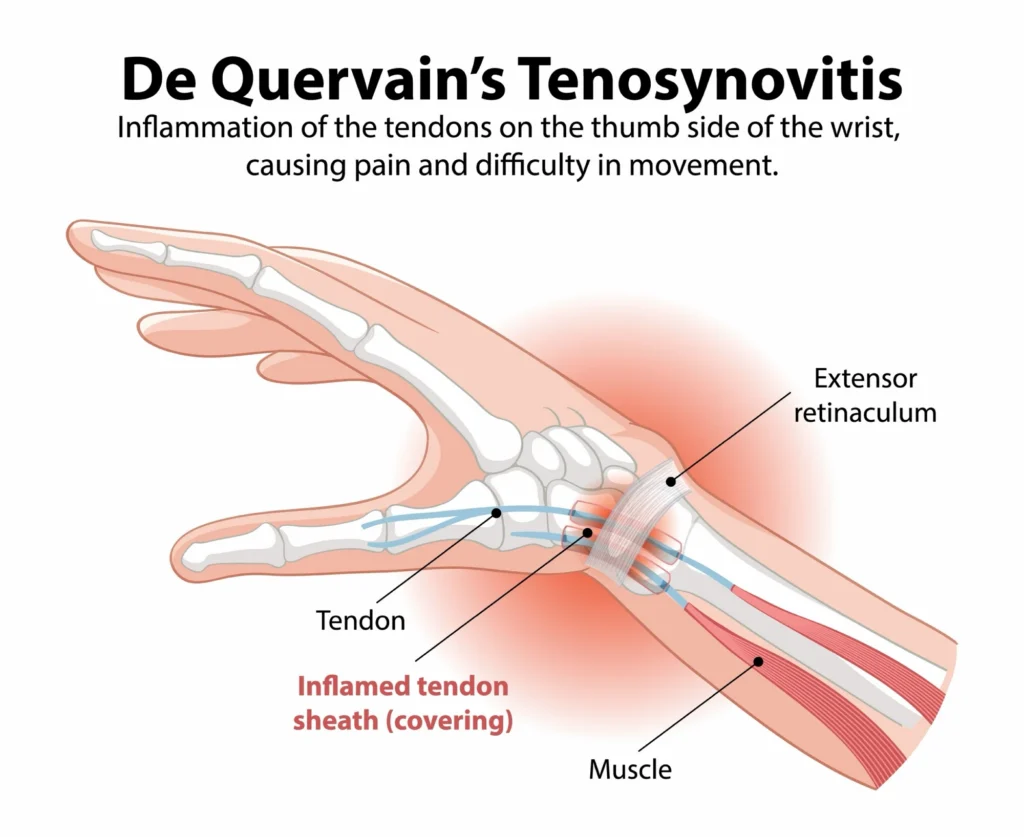
The result is pain and tenderness concentrated at the base of the thumb and along the thumb side of the wrist, often made worse by specific hand motions rather than being constant throughout the day.
What Tends to Bring It On
Repetitive wrist and thumb motion is the common thread behind most cases. Certain occupations and recreational activities involve this kind of repeated movement, which over time can irritate the tendon sheath.
One pattern that’s become increasingly common is related to smartphone and tablet use. Regularly swiping and scrolling puts the thumb through the same repetitive motion over and over, and in the digital age, this has become a contributor to the condition alongside more traditional causes like repetitive gripping, lifting, or hobbies that involve sustained thumb use.
Who Tends to Develop It
This condition is seen more often in women than men, and it shows up with particular frequency during pregnancy and in the months after having a baby, likely related to a combination of hormonal changes and the repetitive lifting that comes with caring for an infant. That said, it isn’t limited to new parents. Anyone whose work or hobbies involve sustained gripping, repetitive lifting with the thumb, or prolonged pinching motions can develop it over time.
Recognizing the Symptoms
The hallmark symptom is pain along the thumb side of the wrist, which tends to worsen with specific movements like grasping an object, making a fist, or twisting the wrist. Swelling over the same area is also common and can sometimes be felt as a firm thickening under the skin.
Some patients notice the pain radiates up into the forearm or down toward the thumb itself, particularly after activities that involve repeated pinching or gripping. Chronic swelling or wrist pain in this area is worth having evaluated rather than managed indefinitely on your own.
What I See in My Patients
In my Jupiter practice, De Quervain’s tends to show up in a few recognizable groups. New parents are a common one, since lifting and carrying an infant repeatedly with the thumbs positioned a certain way puts real strain on that tendon sheath. I also see it in golfers and racquet sport players throughout Palm Beach County, where grip mechanics place repetitive load on the thumb side of the wrist, as well as in patients whose jobs or daily habits involve a lot of repetitive hand use, phones included.
What I try to help patients understand is that this condition is rarely about one single injury. It’s usually the accumulation of repetitive strain over weeks or months, which is also why addressing the underlying activity pattern is such an important part of getting lasting relief rather than just treating the flare-up in front of us.
My Approach to Treatment
At the first visit, I typically recommend a corticosteroid injection directly into the tendon sheath, rather than starting with rest and activity modification alone. The injection targets the irritation right where it’s happening, and in my experience it tends to give patients faster, more reliable relief than a wait-and-see approach.
I do limit how many of these injections I’ll give for this condition. The tendon sheath sits close to the skin surface at the thumb side of the wrist, and repeated steroid injections in that location can thin or discolor the skin over time. I don’t recommend more than two injections total for De Quervain’s.
Identifying and modifying the specific movement that’s driving irritation matters just as much as the injection itself. For a new parent, that might mean adjusting how they lift and hold their baby. For someone whose symptoms are tied to phone use, it might mean using their thumb differently or taking more frequent breaks from scrolling. Treating the flare-up without addressing the underlying habit tends to set patients up for the same symptoms returning down the road.
When a steroid injection doesn’t provide lasting relief, I favor surgical release of the tendon sheath over giving a third injection. It’s a straightforward procedure that I perform under local anesthesia at a surgery center, so patients are awake and comfortable and can drive themselves to and from the appointment rather than arranging a ride. Recovery is generally easy, with most patients back to the majority of their normal activities within two to three weeks. Surgery for De Quervain’s comes up more often than patients tend to expect, and when an injection hasn’t held, it’s usually the more effective next step rather than repeating the injection.
Summary
De Quervain’s tenosynovitis develops when the tendon sheath on the thumb side of the wrist becomes irritated and thickened, usually from repetitive hand and thumb motion, including the kind that comes from frequent phone use. My approach typically starts with a corticosteroid injection at the first visit. When that injection doesn’t provide lasting relief, a straightforward surgical release under local anesthesia is often the better next step, rather than a second or third round of injections.
If you’ve been dealing with thumb-side wrist pain that isn’t settling down, don’t wait for it to become a bigger problem. I see patients throughout Jupiter and Palm Beach County for hand and wrist conditions like this one. You can reach my office at (561) 746-7686 or schedule a consultation online to get an accurate diagnosis and a plan that fits your specific situation.
Frequently Asked Questions
Can De Quervain’s tenosynovitis go away on its own?
Mild cases sometimes improve with rest and activity modification alone, particularly if the repetitive motion driving it is reduced. Many patients, though, find that symptoms persist or return once they resume normal activity, which is when a more structured treatment plan becomes worthwhile.
Is De Quervain’s tenosynovitis related to phone use?
Repetitive swiping and scrolling can be a contributing factor, since it places the thumb through the same repetitive motion over and over. It’s usually one piece of a broader pattern of repetitive hand use rather than the sole cause, but it’s worth being aware of.
How is De Quervain’s tenosynovitis diagnosed?
Diagnosis is typically made through a physical examination, including specific tests that reproduce the pain with certain thumb and wrist movements. Imaging is not usually necessary unless your surgeon wants to rule out another cause of your symptoms.
Will I need surgery for De Quervain’s tenosynovitis?
It’s fairly common for this condition, more so than many patients expect. I usually start with a corticosteroid injection, but when that injection doesn’t provide lasting relief, I favor surgical release of the tendon sheath over repeating the injection. It’s a quick procedure performed under local anesthesia at a surgery center, and most patients are back to the majority of their normal activities within two to three weeks.
How many steroid injections can I have for De Quervain’s?
I don’t recommend more than two total. The tendon sheath at the thumb side of the wrist sits close to the skin surface, and repeated steroid injections in that location can cause thinning or discoloration of the skin. If two injections haven’t provided lasting relief, surgical release is usually a better path forward than a third injection.