Medically reviewed by Veronica Diaz, MD | Reviewed May 2026
Frozen shoulder is one of the most frustrating diagnoses for patients to receive. They come in describing months of worsening shoulder pain, often with no injury to explain it, and by the time they find their way to my office, many have quietly accepted the stiffness as their new normal. Frozen shoulder, while it can be slow to resolve, is treatable. Understanding what is happening in your shoulder, and which stage you are in, can make the entire process feel far less overwhelming.
Key Takeaways
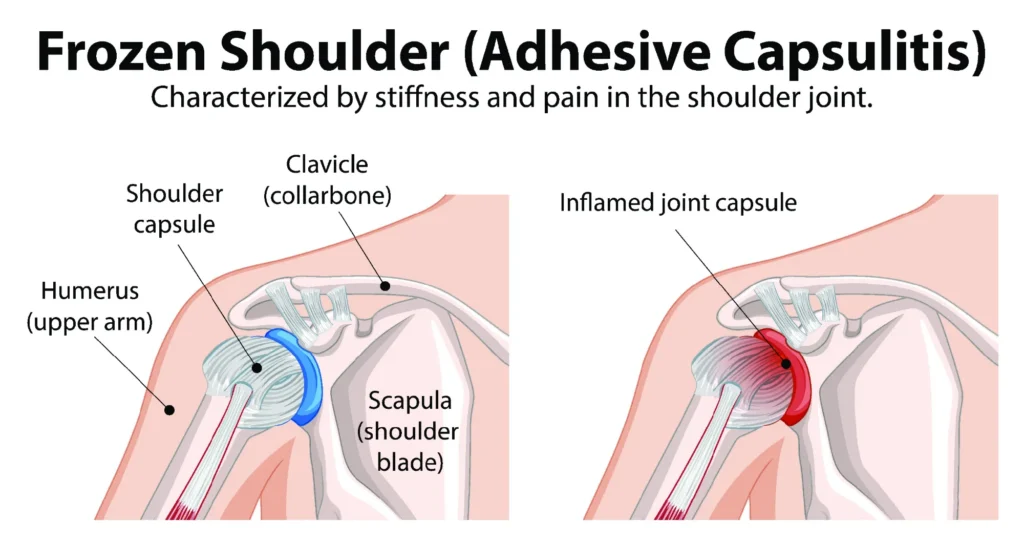
- Frozen shoulder, also called adhesive capsulitis, develops when the capsule lining the shoulder joint becomes inflamed, thickened, and scarred.
- The condition most often affects people between the ages of 40 and 65, with women more commonly affected than men.
- Known risk factors include diabetes, thyroid disorders, and Dupuytren disease.
- An early evaluation with a shoulder specialist can clarify which stage you are in and help prevent unnecessary delays in care.
What Is Frozen Shoulder?
Frozen shoulder (or adhesive capsulitis) is a condition in which the soft tissue capsule that lines the inside of the shoulder joint becomes sequentially inflamed, thickened, and scarred. We do not have a clear understanding of what sets off the process, but patients often point to an event (ex: getting jolted while holding a dog leash, reaching into the back seat of a car) that should not have resulted in long term issues of pain and stiffness. The result is a shoulder that progressively loses range of motion, often while remaining painful throughout the process.
Unlike many shoulder conditions, frozen shoulder frequently develops without any obvious trigger. Some cases do follow a shoulder injury or surgery. But many patients who come into my office in Jupiter and throughout Palm Beach County are puzzled when they first hear the diagnosis. Nothing happened to the shoulder, so why does it hurt?
Sometimes the cause isn’t known, but what is well-established is that certain factors meaningfully raise the risk. Diabetes is among the strongest: patients with diabetes tend to develop more severe cases, experience longer recovery timelines, and are more prone to recurrence. Thyroid disorders, both underactive and overactive, also appear on the risk list, as does Dupuytren disease, a condition affecting the connective tissue of the palm that I treat in my practice as a hand and wrist surgeon. Women are more commonly affected than men, and the condition most frequently presents between the ages of 40 and 65.
The Three Stages of Frozen Shoulder
One of the most useful things I can communicate early to a patient with frozen shoulder is this: the condition is not a single event. It moves through identifiable phases, and knowing which stage you are in directly shapes the approach to care.
Stage 1 — The Freezing Stage
This is when pain comes first. The onset can be gradual, sometimes over weeks, sometimes over months. The shoulder may ache at rest and hurt more with movement. Night pain is particularly common at this stage. Many patients describe being woken up when they roll onto the affected side, which is often how they first realize something is wrong. Range of motion begins to decrease, though not always dramatically at first. In fact, often in the early stages of frozen shoulder, the underlying problem is indistinguishable from other diagnoses such as subacromial bursitis or rotator cuff tendinitis.
Stage 2 — The Frozen Stage
Pain may start to quiet slightly, but the shoulder simply will not move the way it used to. Reaching overhead, getting dressed, and brushing or styling hair become genuinely difficult. Daily independence takes a real hit at this stage. Patients often describe feeling like their shoulder is locked.
Stage 3 — The Thawing Stage
The shoulder gradually begins to recover motion. Pain continues to diminish, and range of motion slowly returns. This stage requires patience. It can take many months to unfold fully. Most cases resolve within 12 to 18 months overall, though some take longer to show meaningful improvement.
What I See in My Patients
The patients who come in early, when pain is the dominant complaint and stiffness has not fully set in, tend to have more flexibility in their treatment options. The ones who wait are often already deep into the frozen stage, with range-of-motion loss and a long road ahead.
What surprises many patients is that frozen shoulder does not always announce itself dramatically. The onset is subtle. A little shoulder achiness when reaching overhead. Some difficulty clasping a bra or pulling a shirt over the head. Night pain that starts to interrupt sleep. By the time the stiffness becomes unmistakable, weeks or months may have already passed.
I also see a pattern worth naming plainly: patients with uncontrolled diabetes or undiagnosed thyroid issues frequently have a more difficult and prolonged course. Getting those underlying conditions under better control is part of the treatment.
My Approach to Treatment
My goal for every frozen shoulder patient is to help them through the process as efficiently as possible with the least invasive approach appropriate for where they are clinically.
For most patients, that starts with a combination of consistent stretching, oral anti-inflammatory medications, and one or more corticosteroid injections, with or without an injectable anti-inflammatory. The timing and frequency of injections matter, and I individualize that based on how the patient is responding. Some patients benefit from formal physical therapy. In many cases, though, a well-guided home stretching program can be just as effective when followed consistently.
Something I emphasize with every frozen shoulder patient that does not always get enough attention: what you eat matters. Adopting a low-inflammation diet (one that is high in fiber and cuts out sugar-laden, processed, and packaged foods) can support recovery in a meaningful way. The evidence linking dietary inflammation to musculoskeletal healing is real, and it is something patients can actually control starting today.
For patients with diabetes or thyroid disease, managing those conditions actively is as important as any specific shoulder treatment. Tight glucose control, in particular, makes a meaningful difference in how frozen shoulder behaves over time. If you have diabetes and you have been diagnosed with frozen shoulder, I may recommend having your hemoglobin A1c level checked, with a target goal of less than 7%.
When Surgery May Be Necessary
The majority of patients with frozen shoulder recover without surgery. That said, some cases, particularly those triggered by trauma, or those that fail to respond to a sustained course of conservative care, may warrant intervention. Surgical options include manipulation under anesthesia, in which the shoulder is gently moved through its range while the patient is under sedation to break up scar tissue, and arthroscopic capsular release, in which the thickened capsule is released under direct visualization.
These are not first-line treatments, and I do not reach for them quickly. But for the right patient who is not making progress with non-surgical care, they may shorten the recovery timeline. If you have been managing frozen shoulder symptoms for several months without meaningful improvement, that is a reasonable point to revisit your plan.
Summary
Frozen shoulder is a slow-moving condition, but treatment options may help accelerate the recovery of motion and reduction of pain. The keys are getting evaluated early, understanding which stage you are in, staying consistent with stretching and lifestyle changes, and actively addressing any underlying conditions, particularly diabetes or thyroid disease, that may be prolonging recovery. Surgery is rarely needed but is available for cases that do not respond to conservative care.
If your shoulder pain and stiffness are disrupting your daily life, the best next step is a consultation to understand exactly where you are in the process and what your options look like. I see patients throughout the Jupiter and Palm Beach County area and welcome the opportunity to help.
Schedule a consultation online or call my office at (561) 746-7686.
Frequently Asked Questions
How do I know if I have frozen shoulder or something else?
Frozen shoulder is often confused with rotator cuff tears, shoulder arthritis, and other conditions that cause pain and stiffness. The distinction matters because the treatment approaches are quite different. A physical examination combined with imaging, typically X-rays and, in some cases, an MRI, can usually clarify the diagnosis. If you have persistent shoulder pain with restricted range of motion and no clear cause, I would encourage you to seek an evaluation rather than waiting it out.
What is the single most important thing I can do for frozen shoulder?
Consistency. The patients who recover most efficiently are the ones who commit to their stretching program and who make the lifestyle adjustments that support healing. That means managing blood sugar if you have diabetes, addressing thyroid issues, staying active within your limits, and following through with the treatment plan in place.
When should surgery be considered for frozen shoulder?
Surgery becomes a reasonable option when non-surgical treatment has been given a genuine trial and significant motion loss or pain persists. Trauma-related and diabetic cases may need more active intervention sooner than cases with no clear cause. This is a decision made together, based on a full review of how you have responded to treatment and what your functional goals are.