Medically reviewed by Veronica Diaz, MD
Two years ago, the topic of GLP-1s didn’t come up nearly as much. Now, I regularly ask my patients whether they are taking a GLP-1 medication. Semaglutide, tirzepatide, and liraglutide have moved from a narrow diabetes treatment into something close to routine here. Patients know them as Ozempic, Wegovy, Mounjaro, and Zepbound. GLP-1 medications and shoulder surgery intersect in ways that can be surprising. If you are on one and surgery is on your calendar, let your surgeon know early.
Key Takeaways
- Although current multisociety guidance released in 2024 suggests most patients can continue their GLP-1 medication before elective surgery, at the facilities where I operate, patients are required by anesthesia to hold their semaglutide/GLP-1 medication for a full week prior to their scheduled surgery.
- The central anesthesia concern is delayed stomach emptying, which may raise the risk of stomach contents reaching the airway during sedation.
- Higher-risk patients, including those still increasing their dose or having stomach symptoms, may be asked to follow a liquid-only diet for 24 hours beforehand.
- Rapid weight loss on a GLP-1 can also result in loss of lean muscle mass. That is worth planning around, since shoulder rehabilitation leans on the muscles surrounding the joint.
What GLP-1 Medications Do
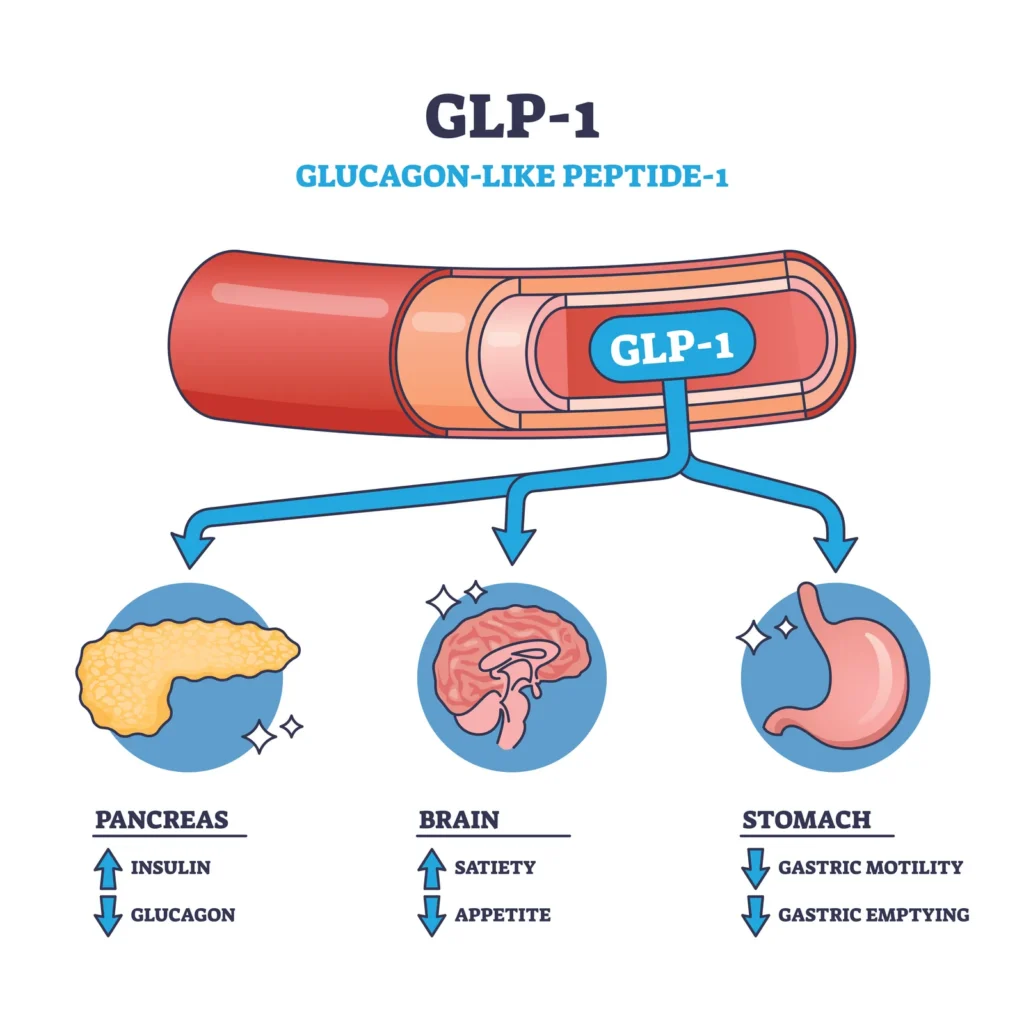
GLP-1 receptor agonists mimic a hormone the gut releases after eating. They prompt the pancreas to release insulin when blood sugar rises. They reduce appetite signaling in the brain. And they slow the rate at which the stomach empties. Food stays in the stomach longer, fullness lasts longer, and people eat less.
For many patients with type 2 diabetes or obesity, these medications have been transformative. I am not in the business of talking anyone out of a medication that is working. My interest is narrower. I care what slowed gastric emptying means on the morning of an operation, and what rapid weight loss means for a shoulder facing months of rehabilitation.
Why Anesthesia Teams Care About Delayed Stomach Emptying
Before any procedure requiring sedation, you are asked not to eat. Anesthesia relaxes the reflexes that normally keep stomach contents where they belong. If the stomach still holds food when those reflexes are suppressed, that material can travel back up the esophagus and into the lungs. This is called aspiration, and while it is uncommon, it can be serious.
GLP-1 medications complicate the assumption behind standard fasting rules. A patient may follow the instructions exactly, eat nothing after midnight, and still arrive with food in the stomach.
What the Current Guidance Actually Says
In 2023, initial advice from the American Society of Anesthesiologists was to hold these medications before elective procedures. In October 2024, five organizations issued joint guidance taking a more measured position. The updated recommendation is that most patients at low risk for delayed stomach emptying can continue their GLP-1 medication before elective surgery. Rather than a blanket rule, the guidance asks the care team to identify who is genuinely at elevated risk. A 2025 consensus statement from another perioperative society also supports continuing these medications, but recommends a 24-hour liquid diet before surgery more broadly. Because hospitals differ, follow the fasting instructions your anesthesia team and surgeon give you. As of this writing, the strict policy of the hospital and surgery center where I perform surgery is to hold GLP-1 medication for a full 7 days prior to your scheduled surgery. If you forget and mistakenly take your GLP-1 medication, your surgery will be canceled.
What the Research Suggests So Far
The orthopedic literature on GLP-1 medications has grown quickly over the past two years. The overall picture has been more reassuring than many surgeons expected. Systematic reviews in shoulder surgery, and in joint replacement more broadly, have generally not found higher complication rates among patients taking these medications.
The Part That Gets Less Attention: Muscle
Here is the piece I find myself discussing more than the anesthesia issue. When people lose weight quickly, some of what they lose is lean tissue, not just fat. Emerging recommendations center on higher protein intake and resistance training during treatment to protect muscle. For most people, that is general health advice. For a patient about to have shoulder surgery, it becomes surgical planning.
Consider reverse shoulder replacement, which I perform for patients with shoulder arthritis and/or a massive or irreparable rotator cuff tear. That operation reverses the ball and socket so the deltoid muscle can take over the work the rotator cuff can no longer do. The result leans heavily on that deltoid. A patient who has lost meaningful muscle mass in the year before surgery starts rehabilitation from a lower baseline. I want to know that going into surgery.
What I See in My Patients
The most common problem is not a bad outcome. It is a missed disclosure.
Patients frequently do not list GLP-1 medications when I ask what they are taking. It does not feel like it belongs on the same list as blood pressure medication. I run into the identical pattern with testosterone replacement therapy, which patients also tend to leave off the list. So, I ask about both by name now.
The other pattern I notice is the patient who arrives thrilled about a substantial weight loss and visibly deconditioned. They have lost a significant amount of weight, their knees feel better, and their shoulder still needs intervention. They are also weaker than they were a year ago. That is a solvable problem, but only if we talk about it before surgery rather than in week six of therapy.
In my Palm Beach County practice, I see more and more patients on these medications. Many fully intend to be back on a tennis court or a golf course. Those goals are often within reach. They just deserve an honest conversation about the starting line.
My Approach to GLP-1 Medications Before Shoulder Surgery
I do not ask patients to discontinue these medications by default. That decision is made together with the anesthesia team and the physician who prescribes the drug.
My concern as a surgeon is that active and significant weight loss places patients in a catabolic state, which makes it more difficult to heal and fight infection. As such, I always advise my patients to maintain their weight as opposed to continue actively pursuing weight loss targets for at least 6 weeks after shoulder surgery.
Alongside that, I talk about protein and resistance training in the weeks leading up to surgery. Anyone losing weight on these medications should be paying attention to protein and doing some form of strength work. With an operation ahead, this point cannot be overemphasized. It is one of the few aspects of surgical preparation you can start the day we schedule the case.
Summary
GLP-1 medications and shoulder surgery can coexist. The research in shoulder and joint replacement surgery has so far been reassuring on complication rates. The concern over loss of lean muscle mass and avoiding a catabolic state prior to major joint replacement surgery is the one I would encourage patients to take more seriously than they usually do, since shoulder rehabilitation asks a great deal of the muscles around the joint, and too much weight loss too quickly can negatively impact wound healing and risk of infection.
If you are taking a GLP-1 medication and you are considering or scheduled for shoulder surgery, bring the specifics to your next visit: the drug, the dose, how long you have been on it, and any stomach symptoms you have had. You can request an appointment online or call my Jupiter office at (561) 746-7686.
Frequently Asked Questions
Do I have to stop Ozempic before shoulder surgery?
YES. Although the 2024 multisociety guidance indicates that most patients at low risk for delayed stomach emptying can continue GLP-1 medications before elective surgery, it is the current policy of the anesthesia teams at the surgery facilities where I operate for all patients on GLP-1 therapy to hold the medication a full week prior to surgery. If you forget and take your GLP-1 within one week of surgery, your procedure will be canceled. Patients can resume their GLP-1 as scheduled after surgery.
What happens if I do not tell my surgical team I am on a GLP-1?
Your anesthesiologist cannot plan around a risk they do not know exists. Without that information, the team may proceed under standard fasting assumptions that do not fit your situation. If the medication comes up on the day of surgery, the case could be delayed or postponed while the team reassesses. Disclosing early gives everyone time to make a plan.
Will being on a GLP-1 medication affect my shoulder recovery?
The published research on complication rates after shoulder and joint replacement surgery has been largely reassuring so far. The consideration I raise with patients is muscle. Rapid weight loss can impair wound healing and make it more difficult to fight infection. It can also lead to a loss of lean tissue, and shoulder rehabilitation depends on the strength of the muscles surrounding the joint. Adequate protein and regular resistance training during weight loss may help protect that foundation.