Medically reviewed by Veronica Diaz, MD | Reviewed June 2026
The question I hear more than almost any other in my office is some version of this: “How do I know if I need shoulder surgery?” That question is rarely easy to answer. But it’s the right one to ask.
I’ve been treating shoulder conditions in Jupiter and throughout Palm Beach County since 2010, and I’ve seen patients at every point along this spectrum. Some come in early, when pain is mild and intermittent. Others arrive after years of working around a shoulder that has quietly deteriorated. In both cases, the decision about surgery deserves a careful, individualized conversation, not a rushed yes or no.
In this post, I’ll walk through what tends to prompt surgery, what can often be managed conservatively, and what specific signs should prompt you to stop waiting and get an evaluation.
Key Takeaways
- Not all shoulder pain requires surgery. Many conditions respond well to physical therapy, activity modification, injections, and other non-surgical approaches.
- Persistent or worsening pain that has not improved with conservative care is one of the clearest signs that a surgical evaluation may be appropriate.
- The right answer depends on your specific diagnosis, how far the condition has progressed, and what you need your shoulder to do.
Understanding the Shoulder
The shoulder is the most mobile joint in the body. It’s built for range of motion, including overhead, behind the back, across the chest, and out to the side. That flexibility comes at a cost. Unlike the hip, which is deeply stabilized by bone structure, the shoulder relies heavily on soft tissue, including the four muscles and tendons of the rotator cuff, the labrum, and the surrounding capsule, to keep the joint centered and functioning properly.
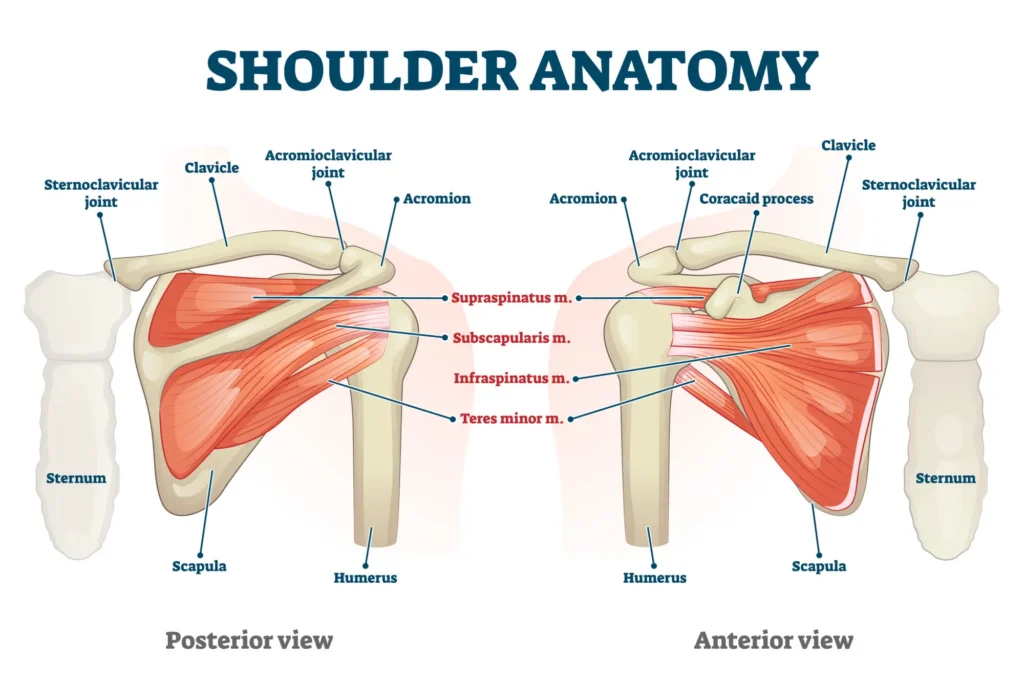
When any of those structures fail, either from wear over time, a traumatic injury, or a combination of both, the shoulder starts compensating. Pain sets in. Motion declines. Strength diminishes.
The specific structure that’s affected, and how severely, is what ultimately drives the conversation about whether surgery is likely to be necessary.
When Conservative Treatment May Be Enough
My approach to shoulder care always starts from the same place: the least invasive option that has a reasonable chance of working. Surgery carries real risks, requires real recovery time, and in many cases is simply not necessary.
For a number of common shoulder conditions, non-surgical treatment can provide meaningful relief. Subacromial bursitis and impingement, early-stage rotator cuff tendinitis, mild osteoarthritis, and frozen shoulder in its early phases can often be managed without a trip to the operating room. A well-structured physical therapy program, activity modifications, anti-inflammatory medications, and appropriately timed injections may all play a role.
The key is giving conservative care a genuine trial. A few weeks of half-hearted stretching is not a failed course of therapy. When conservative treatment has been done correctly and consistently, and symptoms have not improved, that is meaningful clinical information.
Signs That May Point Toward Surgery
There is no single rule that tells you surgery is the right next step. The decision depends on your diagnosis, how long symptoms have been present, how your daily function has changed, and what the imaging shows. That said, several patterns come up repeatedly in my practice as meaningful indicators that a surgical evaluation may be appropriate.
Pain That Has Not Responded to Conservative Treatment
When shoulder pain has persisted for several months despite a well-structured course of physical therapy, activity modification, and injections, continuing to wait is unlikely to change the outcome. The underlying problem is probably not going to resolve on its own at that point. The longer certain conditions, particularly rotator cuff tears and significant arthritis, are left to progress, the more complex the surgical picture becomes.
Constant Nighttime Pain
Nighttime shoulder pain is something I take seriously. Pain that wakes you up when you roll over, that interrupts sleep consistently, or that makes it difficult to find a comfortable position is not just inconvenient. It can signal an advanced stage of the underlying condition. Furthermore, chronic sleep interruption can have negative impacts on overall health. It can lead to memory loss, cognitive decline, and difficulty with interpersonal relationships. Chronic lack of sleep can also make managing chronic conditions such as high blood pressure, diabetes, and heart disease more challenging.
Progressive Loss of Function
Difficulty reaching overhead, getting dressed, washing hair, steering a car, or lifting a grocery bag all tell me something about how the shoulder is functioning. When those limitations are worsening, not holding steady, that trajectory matters. Weakness that has been building over weeks or months is an important signal.
A Traumatic Injury with Clear Structural Damage
A fall, a collision, a forceful pop during a movement: these events can cause acute structural damage that may require surgery. These are scenarios where a prompt evaluation tends to produce better outcomes than a prolonged wait.
Advanced Arthritis with Exhausted Non-Surgical Options
When shoulder arthritis has progressed to the point where medications, therapy, and injections are no longer providing adequate relief, and the condition is significantly affecting quality of life, shoulder replacement may be the most appropriate path forward. Both anatomic total shoulder arthroplasty and reverse shoulder arthroplasty may produce excellent outcomes for the right patients.
What I See in My Practice
The patients I’m most concerned about are not the ones who come in soon after symptoms develop. They’re the ones who have been managing a shoulder that stopped working properly months or years ago, usually because they were hoping things would settle on their own, or because their busy life and work schedules have compelled them to ignore or dismiss the symptoms.
By the time some of these patients find their way to me, the rotator cuff has retracted. The muscle has begun to atrophy. The arthritis has progressed. The surgery that might have been a relatively straightforward repair earlier is now a more complex reconstruction, or perhaps no longer feasible as a repair at all. That is not an outcome I want for any of my patients.
I also see patients who have been offered surgery prematurely, sometimes before trying conservative options. That is the other side of the same problem. My job is to help you understand exactly where you are in the process, what your options look like at this stage, and what the likely trajectory is if you continue on your current path versus if we intervene.
The patients in my Palm Beach County practice who have the best outcomes are the ones who come in with an idea of what they need their shoulder to do, including golfers who want to get back on the course, parents who need to lift their kids without pain, and patients who simply want to sleep through the night again. When I understand what a successful outcome looks like for you specifically, I can make a recommendation that fits your situation.
My Approach to the Shoulder Surgery Decision
Before I ever recommend surgery, I want a complete clinical picture. That means reviewing imaging, doing a thorough physical examination, and having a real conversation about your history, what has been attempted, and how your symptoms have changed over time.
Ask yourself the following three questions:
“Is my shoulder pain interfering with sleep?”
“Am I aware of my shoulder symptoms on a daily basis?”
“Am I giving things up from which I derive pleasure and life satisfaction because my shoulder hurts too much or won’t let me participate?”
If the answer to any of these three questions is “yes”, and if there is a reliable surgical solution for your problem, it may be time to consider surgery.
When the diagnosis is something that may benefit from a surgical procedure, I explain what the procedure involves, what recovery looks like, and what realistic expectations are. I also explain what happens if we do not operate. Both paths have consequences, and you deserve to understand both.
Summary
Knowing whether you need shoulder surgery is not a question with a one-size-fits-all answer. What I can tell you is that certain signals matter: persistent pain that has not improved with conservative care, constant nighttime disruption, progressive weakness and loss of function, and structural damage identified on imaging.
If any of these patterns describe what you’ve been experiencing, the most important next step is an evaluation with a shoulder specialist who will take the time to understand your specific situation, review your imaging, and give you an honest, individualized recommendation about what your shoulder actually needs.
You can request an appointment online or call my office at (561) 746-7686. I see patients throughout Jupiter and Palm Beach County and welcome the opportunity to help you get a clear answer.
Frequently Asked Questions
How long should I try conservative treatment before considering surgery?
The right window depends heavily on the condition, how symptoms are progressing, and what conservative care has actually been tried. “I rested it for a few weeks” is different from a structured course of physical therapy, activity modification, and appropriately timed injections. What I look for is whether a genuine, well-executed trial has run its course without meaningful improvement.
I’ve been told to just live with my shoulder pain. Should I get a second opinion?
If your shoulder pain is affecting your sleep, your independence, or your ability to do the things that matter to you, you deserve a thoughtful evaluation. A second opinion from a fellowship-trained shoulder specialist can give you a clearer picture of what is actually happening and what your options are. An evaluation does not commit you to surgery. It gives you information.
What shoulder conditions do you treat without surgery?
A wide range of shoulder conditions may improve through non-surgical treatments, including mild to moderate rotator cuff tendinitis, frozen shoulder, subacromial bursitis and impingement, early-stage arthritis, and many biceps tendon conditions. For patients who are not candidates for surgery or who prefer to explore all non-surgical options first, I also offer PRP therapy for certain tendon and early arthritis conditions. The right non-surgical plan depends on your specific diagnosis, and I individualize that for every patient I see.