Medically reviewed by Veronica Diaz, MD | Reviewed May 2026
Golfer’s elbow, otherwise known as medial epicondylitis, is one of those conditions that shows up in my office far more often than the name suggests. Most of my patients who come in with inner elbow pain have never picked up a golf club. What they have in common is something far more universal: repetitive stress on a set of tendons that were never designed to take that load, day after day, without a break. Understanding what causes golfer’s elbow is the first step toward treating it well and, just as importantly, knowing when conservative care is enough versus when it isn’t.
Key Takeaways
- Golfer’s elbow (medial epicondylitis) involves degeneration of the tendons on the inner side of the elbow, caused by repetitive gripping and wrist flexion movements.
- Most patients respond well to non-surgical care, including rest, activity modification, physical therapy, and bracing. PRP therapy is a regenerative treatment that may be an option for some patients.
- Persistent symptoms lasting beyond several months, or significant functional loss, may indicate that additional treatment is appropriate.
What Is Golfer’s Elbow?
The medial epicondyle is a bony prominence on the inner side of your elbow. Several tendons attach here, including those that control wrist flexion, forearm rotation and gripping. When these tendons are subjected to repeated stress without adequate recovery time, the tissue can begin to break down. The result is a degenerative process rather than a straightforward inflammation, which is why the condition doesn’t always respond the way patients expect it to.
Golfer’s elbow is sometimes grouped with tennis elbow as a pair of overuse injuries around the elbow. The key distinction: tennis elbow involves the outer side (the lateral epicondyle and the tendons that extend the wrist), while golfer’s elbow affects the inner side. Both are tendinopathies. Both can be stubborn. And both respond better to treatment when the underlying cause is addressed early.
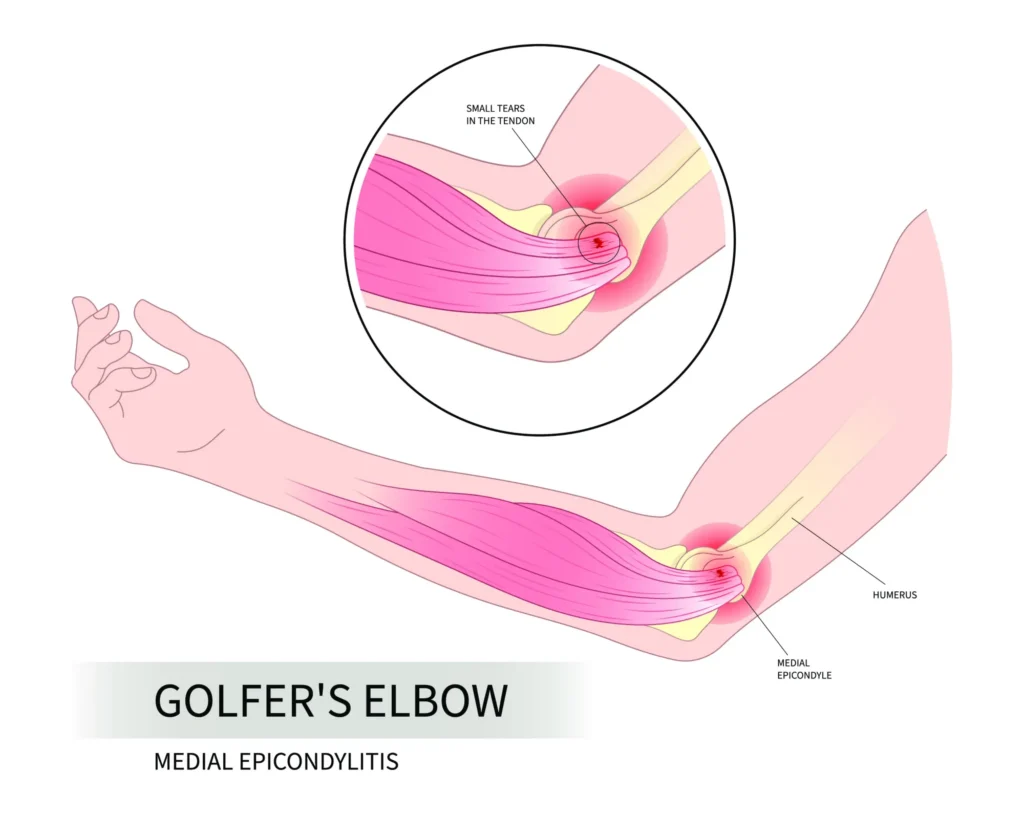
What Causes Golfer’s Elbow?
The short answer is repetitive stress. What that looks like in practice varies a lot from patient to patient.
The name comes from the golf swing, which places significant load on the inner forearm tendons during the downswing and on impact with the ball. But I see this condition in patients who have never golfed. Throwers, particularly baseball pitchers and quarterbacks, are especially vulnerable, as the throwing motion places high tensile loads on the medial elbow structures. Weightlifters who do heavy curls, rows, or deadlifts frequently develop medial epicondyle pain. And then there are patients who work in jobs that require sustained gripping, repetitive lifting, or palm-down forearm rotation: plumbers, carpenters, electricians, and construction workers.
Underlying biology matters too. As tendons age, they lose some of their elasticity and capacity for rapid repair. A 50-year-old whose tendons are already showing some wear may develop golfer’s elbow from a workload that a younger athlete would handle without issue. Poor warm-up habits, sudden increases in activity volume, and muscle imbalances in the forearm all raise the risk as well.
What I See in My Patients
In my Palm Beach County practice, golfer’s elbow tends to come through the door in one of two presentations. The first is an athlete or active person who pushed too hard, added volume too quickly, and woke up one day with a nagging ache on the inside of the elbow. The second is someone who has been tolerating the pain for months, sometimes over a year, before seeking care. By the time they sit down in my exam room, they have often already tried rest, a brace from the pharmacy, and a round of ibuprofen, and nothing has fully worked.
Patients usually describe aching pain along the inner elbow that gets worse when they grip something, especially if the palm is facing down or they’re lifting a heavy object. Tenderness directly over the medial epicondyle is almost always present on exam. Some patients notice their grip strength has decreased, which can affect everything from turning a steering wheel to opening a jar. In more advanced cases, there may be some radiation of symptoms down the inner forearm.
One thing I listen for in every evaluation: is the ulnar nerve involved? The ulnar nerve runs directly behind the medial epicondyle, and it’s not unusual for it to become irritated in the setting of medial epicondyle tendinopathy. Numbness or tingling in the ring and small fingers alongside the typical tendon pain tells me I’m dealing with a more complex picture, and it changes how I approach treatment.
When Does Golfer’s Elbow Need Treatment?
Patients often wait until the pain is affecting their work, their sleep, or their athletic performance before making an appointment. I understand that impulse, but the longer the tendon degeneration has been going on, the more complex the tissue changes tend to be, and the longer recovery typically takes.
If your pain is intermittent and mild, a period of relative rest, activity modification, and some focused stretching may be enough to let things settle. That’s a reasonable first step. But several patterns suggest that a more structured treatment plan is appropriate:
- Pain that hasn’t improved after several weeks of self-directed rest and activity modification
- Symptoms significant enough to limit your work, sport, or daily tasks
- Weakness in grip that is getting worse rather than better
- Pain that keeps returning every time you return to your normal activities
Any of these patterns points toward the need for a formal evaluation. An X-ray may be ordered to rule out bony changes, and in rare instances, an MRI can help characterize the extent of tendon involvement and rule out associated injury to the medial collateral ligament. Getting a clear picture of what’s going on in the tissue helps me build a treatment plan with a realistic timeline rather than a generic one.
My Approach to Treatment
My philosophy with golfer’s elbow, and with most conditions, starts from the same place: whenever possible, I want to use the least invasive approach that has a reasonable chance of working.
Non-surgical treatment typically begins with rest from aggravating activities, along with anti-inflammatory medications if appropriate. A counterforce brace worn just below the elbow can help reduce the load on the affected tendons during daily activity. Physical therapy with a focus on eccentric forearm strengthening or modalities such as dry needling or blood flow restriction is occasionally recommended, but not supported as a mainstay of treatment by the literature.
Additionally, evaluating the mechanics of your golf swing or athletic technique with a golf pro or athletic trainer, as well as making adjustments to your equipment, can help offload the elbow. Similarly, it is important to identify any restrictions in the flexibility of the shoulder or back that could be placing undue strain on the elbow, since the spine, trunk, hips and shoulders are all part of the kinetic chain of a golf swing or tennis stroke.
For patients who have not found adequate relief through initial conservative measures, PRP (platelet-rich plasma) therapy may be worth considering. PRP concentrates growth factors from your own blood and delivers them directly to the degenerative tissue. Because golfer’s elbow involves true tendon degeneration rather than simple inflammation, the regenerative mechanism of PRP can be a better match than repeated corticosteroid injections, which may actually weaken tendon tissue over time. For this reason, I strongly advise against steroid injections for treatment of golfer’s or tennis elbow.
When symptoms persist despite a genuine trial of conservative care, surgical intervention may become appropriate. The procedure involves debridement of the degenerative tendon tissue and repair of the remaining structure. It is performed as an outpatient procedure, meaning patients go home the same day. Recovery involves a period of immobilization followed by progressive rehabilitation and return to sport for most at 12 weeks. Most patients see meaningful improvement, but I always want patients to understand that surgical recovery from tendon procedures takes time. Patience is part of the process.
The Bottom Line
Golfer’s elbow is a common but genuinely treatable condition, and most patients can expect meaningful improvement with the right approach. The key is not waiting too long. Tendons that have been degenerating for a year are more challenging to treat than tendons that have been symptomatic for a month. If your inner elbow pain is interfering with your work, your sport, or the activities that matter to you, that is reason enough to have it evaluated by a specialist.
I treat a wide range of elbow conditions out of my Jupiter office, and I take the time to understand each patient’s specific situation, activity demands, and goals before making any recommendations. If you’re in the Palm Beach County area and dealing with persistent elbow pain, I encourage you to come in for a consultation. You can reach my office at (561) 746-7686 or request an appointment online.
Frequently Asked Questions
Do I have to play golf to get golfer’s elbow?
Not at all. The name is misleading. Golfer’s elbow shows up regularly in patients who work in skilled trades, throw competitively, play racquet sports, or lift weights. Any repetitive activity that loads the tendons on the inner side of the elbow, particularly gripping and wrist flexion movements, can contribute to it.
How is golfer’s elbow different from tennis elbow?
Both involve tendinopathy around the elbow from overuse, but the location is different. Tennis elbow affects the outer side of the elbow (lateral epicondyle), while golfer’s elbow involves the inner side (medial epicondyle). They can occasionally occur together in the same patient, but they involve distinct tendon groups and sometimes respond to treatment differently.
How long does it usually take to recover from golfer’s elbow?
Recovery varies depending on how long symptoms have been present, how severe the tendon degeneration is, and how consistently a patient follows through with treatment. Patients with milder, more recent symptoms may notice improvement within a few months of conservative care. Those with more established degeneration tend to take longer. Surgery, when it becomes necessary, adds additional recovery time. Realistic expectations at the outset make the process a lot less frustrating.