Medically reviewed by Veronica Diaz, MD | Reviewed June 2026
Although the term “shoulder bursitis” may seem straightforward, the condition can be more complex than it appears. Patients come into my Jupiter office describing a nagging ache in the shoulder or arm that seems to flare up when they reach overhead or grab something from behind the back. In many cases, they’ve been pushing through it for months, assuming it will resolve on its own. Sometimes it does. Often, it doesn’t, and by the time they sit down in my exam room, the shoulder has become a real limitation. Shoulder bursitis is treatable, and understanding what’s actually happening in the joint can help you figure out your next step.
Key Takeaways
- Shoulder bursitis involves inflammation of the bursa in the subacromial space, the area between the rotator cuff tendons and the bony roof of the shoulder, called the acromion (which is actually a part of the shoulder blade, or scapula).
- Risk factors include acromion shape, overhead activity, posture, and muscle imbalances in the shoulder girdle.
- Most cases respond well to conservative care, including a targeted physical therapy or home exercise program and, when appropriate, a corticosteroid injection.
- Surgery may be considered if conservative treatment doesn’t provide adequate relief.
What Is Shoulder Bursitis?
The shoulder contains a small, fluid-filled sac called the subacromial bursa. It sits between the rotator cuff tendons and the acromion, which is the bony prominence that forms the ceiling of the shoulder joint. The bursa is there to reduce friction and help the tendons glide smoothly during movement.
When that bursa becomes irritated and inflamed, the result is shoulder bursitis, also referred to as subacromial bursitis or subacromial impingement. The terms may be used interchangeably because they describe the same underlying problem: the soft tissue in the subacromial space gets pinched or compressed between the upper arm bone (humeral head) below and the acromion above, particularly during overhead or behind-the-back movements.
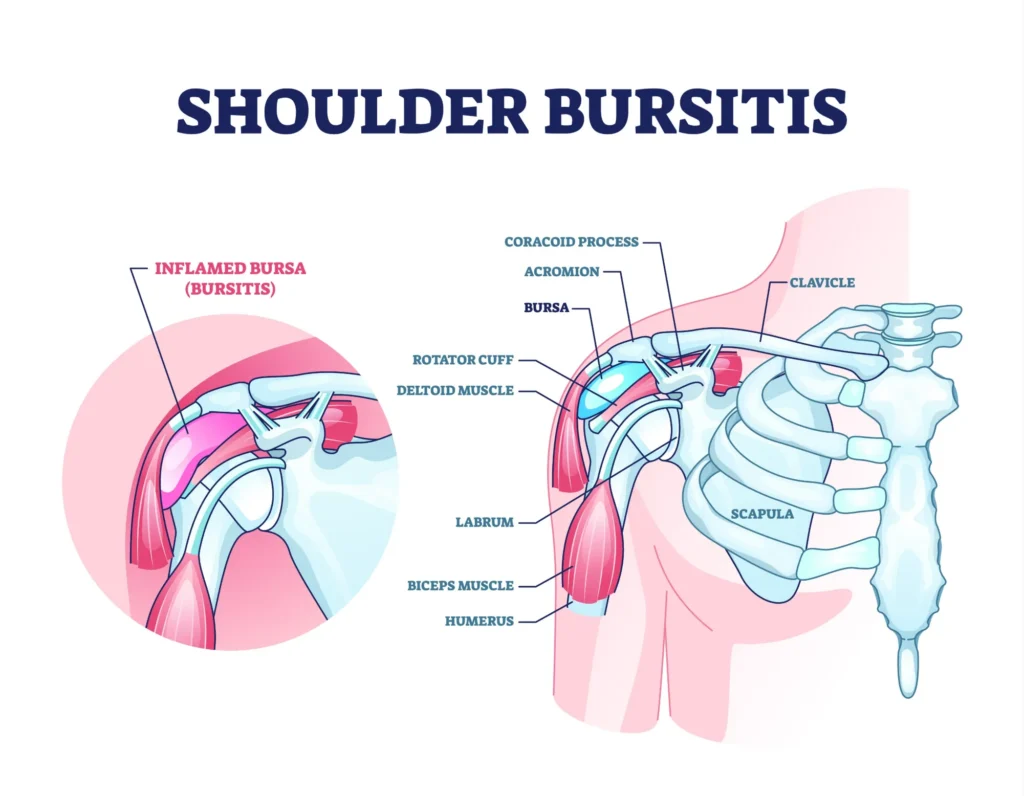
Pain that travels halfway down the outer arm is a common symptom. It tends to be provoked by reaching overhead or behind the back and can worsen with sustained or repetitive activity. Night pain is also common, particularly when rolling onto the affected shoulder.
Who Gets Shoulder Bursitis and Why
Not everyone’s shoulder anatomy is the same. The shape of the acromion varies from person to person, and certain acromion shapes create a tighter subacromial space that leaves less room for the bursa and tendons underneath. That structural predisposition means some patients are simply more prone to developing this condition than others.
Occupational and recreational habits matter enormously as well. Sustained or repeated activities at or above eye level, common in professions like carpentry, painting, or certain trades, as well as overhead sports like swimming, tennis, and baseball, can repeatedly compress the subacromial space and lead to inflammation over time. The body can handle a lot, but repetitive loading without recovery has limits.
Posture is another factor that comes up regularly in my practice. Poor posture, particularly a rounded-forward shoulder position, can reduce the functional space under the acromion and increase the likelihood of tissue compression. This same effect can happen as spinal curvature changes with age and bone loss.
Muscle imbalances in the shoulder girdle, where some muscles are overworked while others underperform, can also alter shoulder mechanics in ways that raise the risk of impingement.
What I See in My Patients
In Palm Beach County, I see a lot of active patients. Laborers, golfers, paddleboarders, tennis players. Shoulder bursitis tends to show up in two ways: either someone pushed hard into a new activity or season and the shoulder couldn’t keep up, or someone has had a low-grade ache for a long time and it finally crossed a threshold they couldn’t ignore.
The patients who tend to have the best results are the ones who come in relatively early, before compensatory muscle patterns set in and before the rotator cuff itself develops secondary problems. And that last part matters: subacromial bursitis doesn’t exist in isolation. When the bursa is chronically inflamed and the tendons underneath are repeatedly compressed, rotator cuff tears can develop or worsen over time. These conditions often coexist.
When I examine someone for possible shoulder bursitis, I’m not just looking at the bursa. I’m trying to understand the whole picture. What is the acromion shape telling me on x-rays? Is there any evidence of rotator cuff involvement? Is poor or suboptimal posture contributing to symptoms? That broader assessment is what informs the best treatment plan.
My Approach to Treatment
My starting point with shoulder bursitis is always the least invasive approach with a reasonable chance of yielding relief. For most patients, that means a structured physical therapy program or a physician-directed home exercise program focused on strengthening the muscles that stabilize the shoulder blade and rotator cuff. This kind of targeted strengthening can reduce impingement by improving how the shoulder functions mechanically. When the muscles that control scapular positioning are working well, the subacromial space tends to open up and the pinching decreases.
For patients whose pain is high enough to interfere with sleep or daily activity, I may recommend a corticosteroid injection into the subacromial space. A well-placed injection can calm down the inflammation enough to allow meaningful participation in therapy. I use this tool selectively. Injections alone are not a long-term solution, but as part of a broader treatment plan, they can be genuinely helpful.
For patients dealing with chronic tendon changes alongside bursitis, PRP therapy may be worth discussing as well. PRP concentrates growth factors from the patient’s own blood and delivers them directly to the damaged tissue. For rotator cuff tendinitis or partial tears that have not responded to standard conservative care, it may offer a regenerative approach that targets the underlying tissue problem rather than just the inflammation. In fact, a recent study randomized patients to receive either PRP therapy or a steroid injection for this problem, and while both treatment options worked, PRP helped more people avoid surgery.
When conservative treatment genuinely hasn’t worked and symptoms persist, surgery may be appropriate. The most common approach is an arthroscopic procedure to remove inflamed tissue and smooth out the undersurface of the acromion. This relieves the mechanical compression that has been driving the problem. If I identify a co-existing rotator cuff tear during that evaluation, the surgical plan adjusts accordingly. I perform these procedures arthroscopically, which involves small incisions and generally allows for a faster recovery compared to open approaches.
The right path depends on the individual. A recreational golfer in his 50s with early bursitis and normal rotator cuff function has different options than someone whose imaging shows significant bony impingement and a partial rotator cuff tear. I’d rather take the time at the outset to understand your full picture than apply a one-size-fits-all protocol.
What Recovery Looks Like
For patients who respond to conservative management, improvement can happen over several weeks to a few months, depending on how long symptoms have been present and how consistently the exercise program is followed. Patients who commit to the program tend to do better than those who do it when convenient.
For those who proceed with arthroscopic surgery, recovery follows a more defined course. After a short period of post-operative protection, gradual rehabilitation begins. Desk workers can often return relatively quickly; patients with physically demanding work or overhead activity requirements need more time. Formal physical therapy, when indicated, typically begins a few weeks after surgery and progresses through range-of-motion, strengthening, and functional activity phases.
Recovery takes consistency. But with the right approach, most patients can get back to the activities that matter to them.
Summary
Shoulder bursitis is a common but manageable condition. The right treatment depends on your anatomy, your activity demands, how long symptoms have been present, and whether any other shoulder pathology is contributing. Most patients do well without surgery. Those who undergo an arthroscopic procedure generally recover well and return to full activity.
If your shoulder has been limiting what you can do, whether that’s reaching overhead, sleeping through the night, making a living, or getting through a round of golf or a tennis match without pain, that’s reason enough to get it evaluated. An accurate diagnosis puts you in a much better position to make good decisions about your care.
I see patients throughout the Jupiter and Palm Beach County area. You can reach my office at (561) 746-7686 or schedule a consultation online. The first step is figuring out exactly what is going on in your shoulder.
Frequently Asked Questions
How do I know if my shoulder pain is bursitis or something else?
Shoulder pain can come from many sources, including rotator cuff tears, AC joint arthritis, frozen shoulder, and biceps tendon problems. Bursitis tends to cause pain on the outer side of the shoulder and upper arm that is provoked by overhead or behind-the-back movements. That said, a physical examination and imaging are needed to confirm the diagnosis and rule out other contributing conditions.
Can shoulder bursitis go away on its own?
It can, particularly in early or mild cases where an activity modification and some targeted exercises are enough to allow the inflammation to settle. But many patients find that the pain keeps returning whenever they try to resume normal activity. If symptoms are persistent, worsening, or limiting your function, a structured evaluation and treatment plan is a better path than continued waiting.
Do I need surgery for shoulder bursitis?
Most patients do not. The majority of shoulder bursitis cases respond well to a combination of physical therapy or home exercises, activity modification, and, in some cases, a corticosteroid injection. Surgery becomes a reasonable option when conservative treatment has been genuinely pursued and has not provided lasting relief, or when imaging reveals a structural contributor, such as a prominent acromion or a co-existing rotator cuff tear, that is driving the problem.
What should I do if I think I have shoulder bursitis?
Start with an evaluation from an experienced shoulder specialist. A consultation does not commit you to treatment. What it does is give you an accurate picture of what is happening in your shoulder, which puts you in the best position to make a thoughtful decision about next steps. If conservative care is the right path, we will map that out. If something more is needed, you will know that too.