Medically reviewed by Veronica Diaz, MD | Reviewed July 2026
Most of the golfer’s elbow patients who sit down in my exam room never end up needing surgery, and I tell them that upfront because it tends to ease a lot of the anxiety that comes with a new diagnosis. I almost never operate on elbow tendinopathy. But a small number of patients do reach the point where golfer’s elbow surgery is the right next step. This post covers exactly that: how I evaluate candidacy, what the procedure itself involves, and what recovery realistically looks like. If you haven’t gone through conservative treatment yet, you can start with my earlier post on what causes golfer’s elbow and how I approach it non-surgically.
Key Takeaways
- Golfer’s elbow surgery is generally reserved for patients who haven’t found adequate relief after a genuine trial of conservative treatment.
- Candidacy depends on more than just pain. Duration of symptoms, functional loss, and ruling out other causes with imaging all factor into the decision.
- The procedure involves debridement of the degenerative tendon tissue and repair of the remaining structure, performed as an outpatient surgery.
Where Surgery Actually Fits In
My approach to golfer’s elbow, like most tendon conditions I treat, starts with the least invasive option that has a real chance of working. That usually means rest from the aggravating activity, a counterforce brace, physical therapy, and in some cases platelet-rich plasma therapy for patients whose tendon has genuinely degenerated rather than simply inflamed. Most patients improve with this approach, and I mean that. I also don’t recommend steroid injections for this condition. Golfer’s elbow involves true tendon degeneration rather than simple inflammation, and steroids can weaken tendon tissue further rather than help it heal. Surgery is not the default path for golfer’s elbow, and it shouldn’t be treated as one.
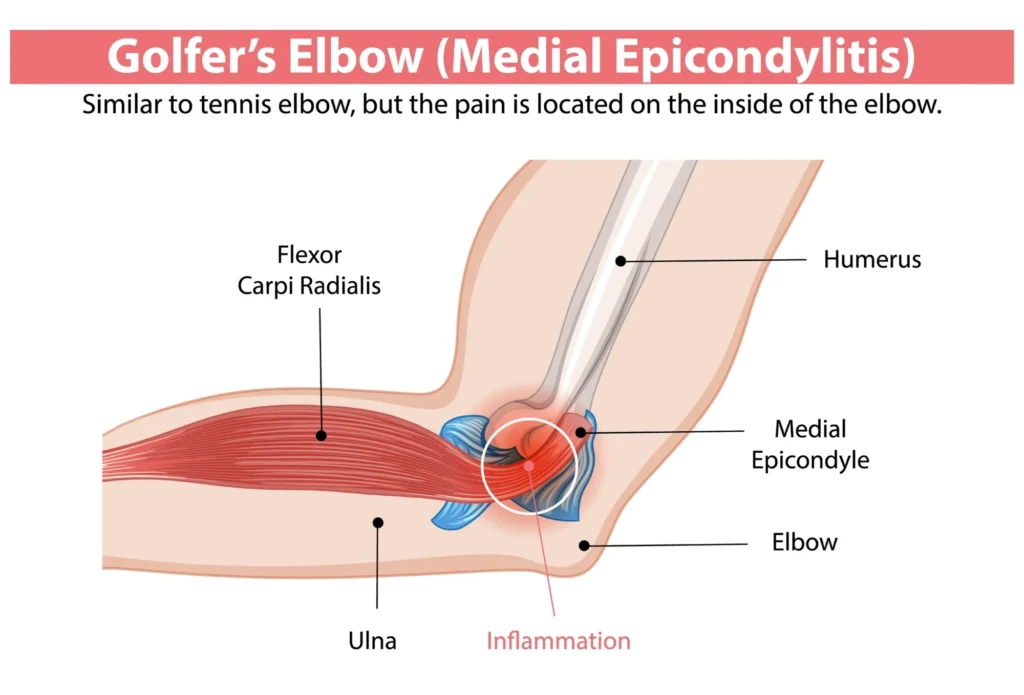
That said, tendon degeneration doesn’t always respond to conservative measures, particularly when it’s been present for a long time before treatment even starts. When symptoms are persistent, significant, and unresponsive to a genuine trial of non-surgical care, surgery may become a reasonable option.
What Determines Candidacy for Surgery
There’s no single test that tells a patient they need surgery. It’s a picture built from several pieces of information, and I walk through all of them before recommending an operation.
The first is time and effort already invested in conservative care. I want to see that rest, activity modification, bracing, and physical therapy were genuinely tried, not just attempted for a week or two. Patients whose pain hasn’t improved after self-directed rest and activity modification, and who have gone on to a structured course of therapy without lasting relief, are the ones for whom surgery starts to make the most sense.
The second is functional impact. Weakness in grip that’s getting worse, or pain that keeps returning every time a patient tries to resume normal activity, tells me the tendon hasn’t stabilized on its own. That kind of pattern is different from someone whose pain is annoying but not actually limiting daily life or sport.
The third is imaging. An X-ray helps rule out bony changes and other explanations for persistent elbow pain before surgery is ever part of the conversation.
One thing I always check for specifically: whether the ulnar nerve, which runs directly behind the medial epicondyle, is involved. Numbness or tingling into the ring and small fingers alongside the typical tendon pain changes the clinical picture and can influence both the surgical plan and the expected recovery.
What the Surgery Actually Involves
Golfer’s elbow surgery involves debridement, removing the degenerative tendon tissue, followed by repair of the remaining healthy structure. It’s performed as an outpatient procedure, meaning patients go home the same day rather than staying overnight.
I want to be direct about something here: this is a tendon procedure, not a quick fix. The tissue being repaired has typically been degenerating for months or longer by the time surgery happens, and that biology doesn’t reverse itself overnight just because the damaged tissue has been addressed surgically.
What Recovery Actually Looks Like
Recovery follows a period of immobilization to protect the repair, followed by progressive rehabilitation. This isn’t a procedure where patients are back to full activity within a couple of weeks, and I make sure every patient understands that going in. Most patients return to sport around the 12-week mark, and that timeline reflects how tendon tissue heals, not how quickly someone wants to get back on the course. The patients who do best with this recovery are the ones who treat the early rehabilitation phase seriously and don’t try to rush back to swinging a club or gripping tools before the tissue is ready. Patience is part of the process here.
What I See in My Patients
In my Palm Beach County practice, the patients who end up as surgical candidates tend to fall into a specific pattern: they’ve usually been dealing with symptoms for a long time, tried a brace from the pharmacy and some rest on their own before ever coming in, then gone through a genuine course of formal treatment with me and still aren’t where they need to be. By the time we’re having the surgery conversation, most of these patients already have a good intuitive sense that conservative care has run its course.
What I try to correct early is the expectation that surgery is a shortcut. It isn’t. It’s the right tool for a specific situation, and when it’s genuinely indicated, it works well. But it comes with a real recovery timeline, and I’d rather set that expectation clearly upfront than have a patient frustrated at week six wondering why they aren’t back to full strength yet.
Questions Worth Asking Before Surgery
- Has my conservative treatment truly been given enough time and effort?
- Has imaging ruled out other explanations for my elbow pain?
- Is the ulnar nerve involved?
- What does a realistic recovery and return-to-sport timeline look like for my specific case?
- Are there regenerative options, like PRP, that make sense for me?
Summary
Golfer’s elbow surgery is reserved for a smaller group of patients: those with persistent, functionally limiting symptoms who haven’t found lasting relief through a genuine trial of conservative care. Candidacy comes down to how long symptoms have lasted, how much they’re affecting daily function and grip strength, and whether imaging has ruled out other explanations for the pain. The procedure involves debridement and repair on an outpatient basis, and recovery takes real time, with most patients returning to sport around 12 weeks.
If you’ve been managing golfer’s elbow symptoms for months without meaningful improvement, the next right step is a focused evaluation to determine where you actually stand. I see patients throughout Jupiter and the surrounding Palm Beach County area. You can reach my office at (561) 746-7686 or request an appointment online to find out whether surgery genuinely makes sense for your situation, or whether there’s more room to work with conservative care first.
Frequently Asked Questions
How do I know if I’ve truly exhausted conservative treatment for golfer’s elbow?
Conservative treatment generally needs to include rest, activity modification, a period of bracing, and formal physical therapy, given a genuine trial of several months. If you’ve only tried one of these, or tried them briefly, there’s usually more room to work with non-surgical care before surgery is the right conversation.
Is PRP an alternative to surgery for golfer’s elbow?
PRP therapy may be worth considering for tendon degeneration that hasn’t responded to initial conservative measures, since it targets the underlying tissue rather than just calming inflammation. It isn’t right for everyone, but it’s a step we can discuss before committing to surgery.
Are steroid injections used to treat golfer’s elbow?
I don’t recommend them for this condition. Golfer’s elbow involves genuine tendon degeneration rather than simple inflammation, and steroids can weaken the tendon further rather than help it heal. I favor bracing, physical therapy, and PRP over steroid injections here.
Will numbness or tingling in my fingers affect my surgical plan?
It can. Numbness or tingling in the ring and small fingers may indicate that the nearby ulnar nerve is irritated, which is something I evaluate specifically before recommending surgery, since it can influence both the procedure itself and the recovery process.
Is golfer’s elbow surgery a major operation?
It’s performed as an outpatient procedure, so you go home the same day. That said, it’s a tendon repair, and the recovery timeline should be taken seriously rather than treated as a minor inconvenience.