Medically reviewed by Veronica Diaz, MD | Reviewed August 2026
Many of the patients I see in my Jupiter office don’t have a torn rotator cuff or a shoulder that’s been dislocated. Instead, they’re dealing with pain that gradually develops over time: discomfort when reaching overhead, aching when reaching behind the back, or shoulder pain that makes it difficult to sleep. Once we determine that shoulder impingement is the cause, one of the first questions I hear is whether it could have been prevented. While not every case is avoidable, there are practical steps that can reduce your risk and help prevent shoulder impingement.
Key Takeaways
- Shoulder impingement develops when soft tissue in the subacromial space gets repeatedly pinched between the upper arm bone and the bony roof of the shoulder.
- Posture, overhead activity, and muscle imbalance are risk factors you can influence. The shape of your acromion is not.
- Catching symptoms early, before compensatory patterns set in, makes treatment simpler if prevention isn’t enough.
What’s Actually Happening in the Shoulder
Beneath the bony roof of the shoulder (the acromion) sits a small space that houses the rotator cuff tendons and a fluid-filled cushion called the bursa. That space is not particularly generous to begin with, and certain movements, especially reaching overhead or behind the back, narrow it further. When the tissue in that space gets compressed too often, it becomes irritated and inflamed. That’s impingement.
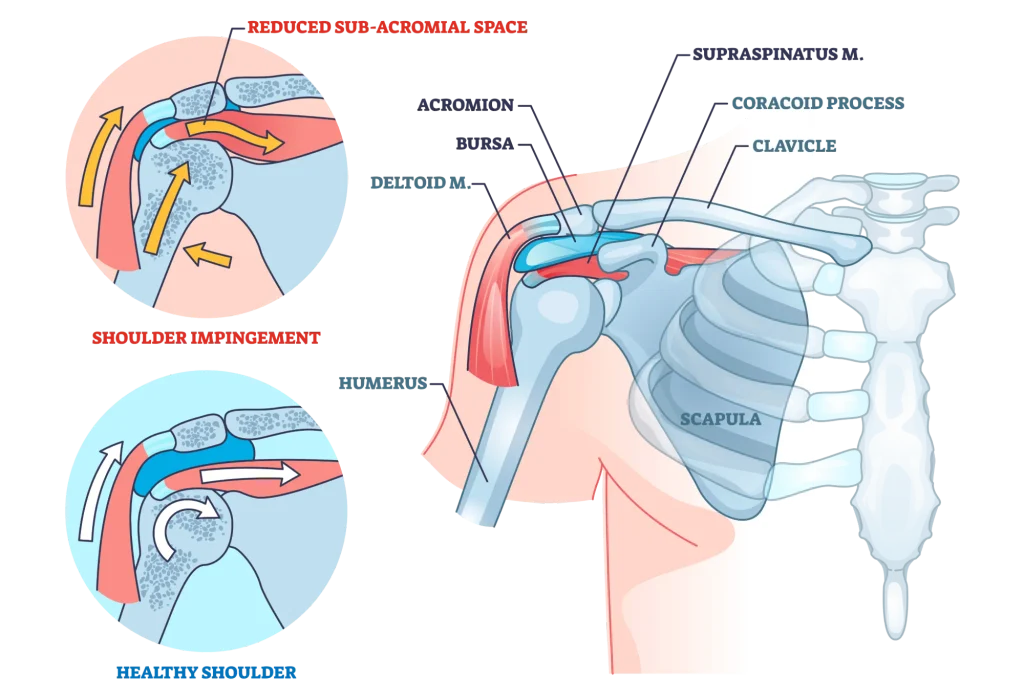
Some people are simply built with less room in that space than others. The shape of the acromion varies from person to person, and a more prominent or hooked shape leaves less clearance. That part of the equation isn’t something you can train your way around. But it also isn’t the whole story, which is where prevention has something to offer.
The Habits That Raise Your Risk
Anatomy sets the stage, but daily habits often determine whether symptoms actually develop, which is where the opportunity to help prevent shoulder impingement lies.
Sustained or repeated work at or above eye level is the most common pattern I see. Painters, electricians, and anyone doing overhead installation work put that subacromial space through repetitive compression, day after day, without much recovery time in between. The same is true for overhead sports like tennis, swimming, and volleyball, and increasingly for pickleball, which has brought a wave of new overhead-motion injuries into orthopedic offices across South Florida.
Posture matters more than most people expect. A rounded-forward shoulder position, the kind that develops from long hours at a desk or hunched over a phone, quietly shrinks the functional space under the acromion. Over months and years, that adds up. The same shift can happen with age as spinal curvature changes and bone density declines.
Muscle imbalance is the third piece. When certain shoulder muscles are doing too much work while others barely engage, the mechanics of the joint shift in ways that increase compression. This is modifiable, and it’s where I spend most of my time with patients who want to be proactive.
Building a Shoulder That Resists Impingement
The shoulder blade needs to rotate and tilt in coordination with the arm for that subacromial space to stay open during overhead motion. When the muscles that stabilize the shoulder blade, particularly the lower trapezius and serratus anterior, are weak or under-activated, the space narrows and impingement becomes far more likely.
A few practical habits may help:
- Build in posture breaks during desk work or phone use. Even brief resets, rolling the shoulders back and opening the chest, reduce the cumulative load on that subacromial space.
- Warm up before overhead sports. A few minutes of scapular activation before serving a tennis ball or hitting the pickleball court can make a measurable difference.
- Strengthen the muscles that stabilize the shoulder blade, not just the ones that move the arm. A physical therapist or a home program can target this specifically.
- Pace overhead workloads. Painters and contractors who alternate tasks throughout the day tend to fare better than those who spend hours in a single overhead position.
None of this guarantees you’ll never develop impingement. What it does is meaningfully shift the odds, and in my experience, patients who build these habits tend to have milder episodes when symptoms do show up.
What I See in My Patients
Palm Beach County has an active population. I see plenty of pickleball and tennis players whose shoulders simply couldn’t keep pace with a sudden jump in court time. I see painters and electricians whose jobs never really give the subacromial space a break. And I see a growing number of patients, often in their 40s and 50s, whose symptoms trace back less to any single activity and more to years of forward-rounded posture catching up with them.
What stands out to me is how many patients wait until the pain is disrupting sleep before they bring it up. Impingement symptoms tend to start subtly, an ache when reaching for something on a high shelf, discomfort mid-swing. Patients who mention it early, before compensation patterns set in elsewhere in the shoulder, generally have an easier road, whether that road involves prevention alone or a bit of formal treatment.
When Prevention Isn’t Enough
Good habits lower your risk, but they don’t eliminate it, and I don’t want anyone reading this to feel like developing impingement means they did something wrong. If you’re already dealing with pain that hasn’t responded to a few weeks of rest and postural correction, that’s worth a proper evaluation rather than continued self-management. I’ve written a full breakdown of the diagnosis and treatment side of shoulder bursitis and subacromial impingement, including when physical therapy, injections, or surgery come into the conversation, if you want to understand what that path looks like.
The same general framework applies here that I use for most shoulder conditions I treat out of my Jupiter office: start with the least invasive option that has a reasonable shot at working, and escalate only when it’s needed. Prevention is simply the earliest and lowest-risk version of that same philosophy.
Summary
Shoulder impingement develops when the tissue in the subacromial space gets repeatedly compressed, and while your anatomy plays a role, posture, overhead workload, and scapular muscle strength are all factors you can influence. Building postural awareness into your day, warming up before overhead sports, and strengthening the muscles that stabilize your shoulder blade are the most effective steps most patients can take on their own.
If you’ve been managing shoulder discomfort for a few weeks without real improvement, don’t wait it out indefinitely. I see patients throughout Jupiter and Palm Beach County, and an evaluation can tell you quickly whether you’re dealing with early impingement, something else entirely, or simply need a smarter approach to the activities you love. You can reach my office at (561) 746-7686 or schedule a consultation online.
Frequently Asked Questions
Can shoulder impingement be fully prevented?
Not entirely. Some risk comes from the shape of your acromion, which isn’t something you can change. But posture, overhead workload, and scapular muscle strength are all modifiable, and addressing them can meaningfully lower your risk or reduce the severity of symptoms if they do develop.
What’s the difference between shoulder impingement and shoulder bursitis?
In practice, these terms describe the same underlying problem: soft tissue in the subacromial space getting compressed between the upper arm bone and the acromion. Some clinicians use one term more than the other, but they refer to the same condition.
I already had shoulder impingement once. Can it come back?
It can, especially if the underlying contributors, posture, overhead workload, or muscle imbalance, weren’t addressed the first time. Patients who build in the preventive habits after an initial episode tend to have a lower chance of recurrence.
When should I stop trying to manage shoulder pain on my own?
If pain persists beyond a few weeks despite rest and activity modification, or if it’s disrupting your sleep or daily function, it’s time for a proper evaluation rather than continued self-management. Catching a developing problem early generally makes treatment simpler.